
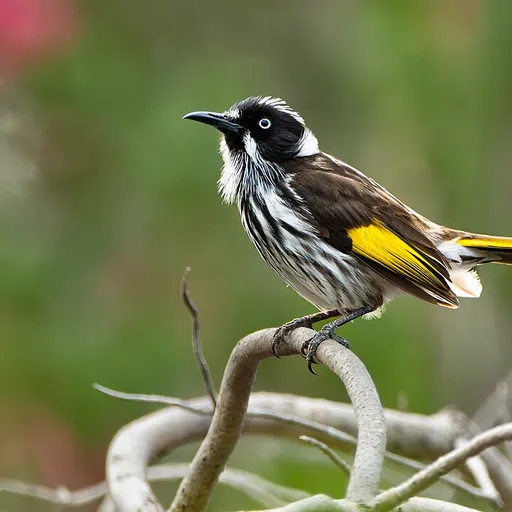
New Holland Honeyeater
Phylidonyris novaehollandiae
Least Concern
Overview
The New Holland honeyeater (Phylidonyris novaehollandiae) is a honeyeater species distributed throughout southern Australia. It is classified as a species of Least Concern on the IUCN Red List and was among the first birds to be scientifically described in the region.
Identification
- Approximately 18 cm (7.1 in) in length, with plumage that is mainly black featuring white facial tufts and yellow margins on the wing and tail feathers.
- Possesses a distinctive white iris, contrasting with the grey eyes found in young birds under one year of age.
- Very active in the field and rarely sits long enough to provide an extended view; groups may issue warning calls when predators approach.
- Females are on average slightly smaller than males, otherwise the sexes appear similar.
Habitat
Found throughout southern Australia, with different subspecies occupying specific regions including southeast Queensland to southeast South Australia, Tasmania, Kangaroo Island, and southwest Western Australia. The species is present in both coastal and inland areas of this range.
Diet
Obtains most carbohydrate requirements from flower nectar, making it a key pollinator for endemic plants such as Banksia, Hakea, Xanthorrhoea, and Acacia. It supplements this diet with honeydew and invertebrates like spiders and insects to obtain necessary protein. Foraging typically occurs in groups, though they occasionally feed alone.
Did you know?
The New Holland honeyeater was among the first birds to be scientifically described in Australia, with its formal description dating back to 1790 by the English ornithologist John Latham.
Sources
- Wikipedia · CC BY-SA 4.0
- Wikidata · CC0 1.0