
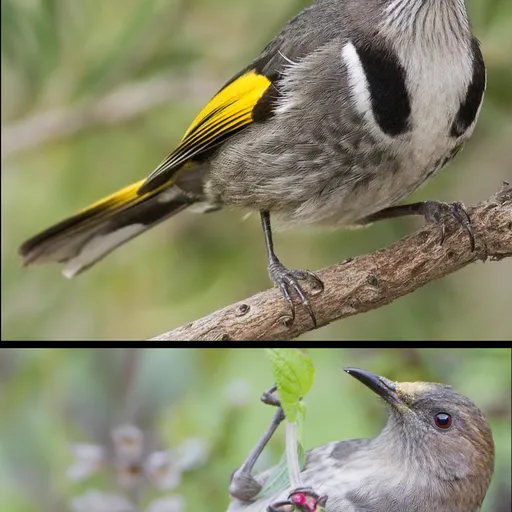
Crescent Honeyeater
Phylidonyris pyrrhopterus
Least Concern
Overview
The crescent honeyeater (Phylidonyris pyrrhopterus) is a passerine bird of the honeyeater family Meliphagidae native to southeastern Australia. It is closely related to the common New Holland honeyeater and the white-cheeked honeyeater, and is classified as a species of Least Concern on the IUCN Red List.
Identification
- Measures 14–17 cm in length, with a wingspan of 16–23 cm and a weight of approximately 16 g.
- Features dark grey plumage with paler underparts, highlighted by yellow wing-patches and a broad, black crescent outlined in white down the sides of the breast.
- Possesses a long, downcurved black bill, dark grey legs and feet, and deep ruby eyes; males have a white streak above the eye.
- Males produce a complex and variable song heard throughout the year from exposed perches, often accompanied by song flights during the breeding season.
Habitat
Native to southeastern Australia, the species is widespread in New South Wales south of Dharug National Park and east of Bathurst, across Victoria, and in Tasmania. It inhabits a variety of dense vegetation types, including sclerophyll forest, alpine woodland, heathland, and urban parks and gardens. Populations in South Australia are restricted to the Mount Lofty Ranges and Kangaroo Island.
Diet
The crescent honeyeater forages among foliage and flowers for nectar, fruits, and small insects, including the honeydew of psyllids and scale insects. It feeds primarily by probing flowers, gleaning foliage and bark, and sallying for insects. During the breeding season, its diet may consist wholly of insects, while nectar becomes a significant component in winter.
Did you know?
Despite maintaining long-term social partnerships, the species is sexually promiscuous; one study found that only 42% of nestlings were sired by the male partner at the nest. This genetic promiscuity is consistent with reduced male contribution to caring for the young and frequent toleration of female intrusions into other territories.
Sources
- Wikipedia · CC BY-SA 4.0
- Wikidata · CC0 1.0