
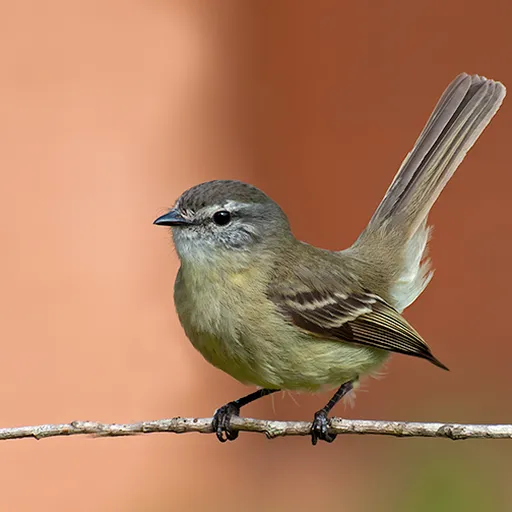
Planalto Tyrannulet
Phyllomyias fasciatus
Least Concern
Overview
The planalto tyrannulet (Phyllomyias fasciatus) is a species of bird in the family Tyrannidae, commonly known as the tyrant flycatchers. It is classified as Least Concern on the IUCN Red List, indicating a large range and no immediate threats, although its population is believed to be decreasing.
Identification
- Dull grayish-olive to brownish-olive upperparts with a darker crown.
- Whitish lores, supercilium, and partial eyering contrasted by a dark stripe through the eye.
- Dusky wings featuring two pale bars on the closed wing and a dusky tail.
- Whitish throat and yellow underparts with an olive wash on the breast and sides.
- A short, stubby blackish bill, gray legs, and brown iris.
- Song varies geographically, ranging from a slow series of 3–4 slightly descending 'puh-puh--' minor-key notes to a higher-pitched series of 3 major-keyed notes.
Habitat
Found in Argentina, Bolivia, Brazil, and Paraguay, the planalto tyrannulet primarily inhabits humid tropical evergreen forest, though it is occasionally seen in semi-deciduous woodland and gallery forest. Its elevation range spans from sea level to 1,800 m, with the highest density occurring between 500 and 800 m.
Diet
This species feeds on insects and small fruits. It typically forages singly or in pairs within the forest canopy, often joining mixed-species feeding flocks. Prey is taken from vegetation by gleaning while perched and briefly hovering.
Did you know?
Nesting has only been recorded once, involving a cup constructed from moss and fungal hyphae, which was covered inside and out with lichen. This unique structure was placed 7 m above the ground in a branch crotch and contained two eggs.
Sources
- Wikipedia · CC BY-SA 4.0
- Wikidata · CC0 1.0