
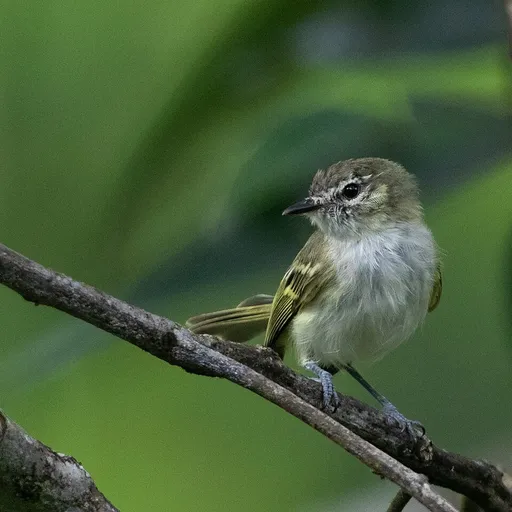
Alagoas Tyrannulet
Phylloscartes ceciliae
Critically Endangered
Overview
The Alagoas tyrannulet (Phylloscartes ceciliae) is a Critically Endangered species of tyrant flycatcher endemic to far northeastern Brazil. It is a year-round resident of the Atlantic Forest, where its population is believed to be decreasing due to habitat loss.
Identification
- Size: Small bird measuring 11 to 13 cm in length and weighing between 6.8 and 8.4 g.
- Plumage: Sexes are similar, featuring a dark olive green crown, nape, back, and rump, with blackish olive wings showing two distinct wing bars formed by wide greenish yellow tips.
- Head Markings: Adults display a thin whitish supercilium and an ashy blackish streak through the eye that sweeps around the whitish ear coverts.
- Underparts: Throat and breast are whitish with a dark green wash on the sides, while the belly and undertail coverts have a very pale yellow wash.
- Vocalisation: Song consists of one to three snappy, squeaky rising notes followed by a Furnariid-like chatter of sharp, overslurred notes; primary call is a short, nasal, sharply rising 'chweep' note.
Habitat
Restricted to eastern Pernambuco and northeastern Alagoas states in Brazil, the species inhabits remnants of primary evergreen forest and mature secondary forest within the Atlantic Forest. Its elevational range is generally cited between 400 and 550 m, though some estimates extend this to 160 and 980 m.
Diet
This bird feeds primarily on insects, foraging actively in the mid-story to canopy between 6 and 15 m above the ground. It typically perches horizontally, sometimes with its tail cocked up, making short sallies to grab or hover-glean prey from leaves and twigs, often in pairs or within mixed-species flocks.
Did you know?
The specific epithet ceciae was chosen by the describing author, Dante Martins Teixeira, in memory of his late wife, Cecelia Torres.
Sources
- Wikipedia · CC BY-SA 4.0
- Wikidata · CC0 1.0