
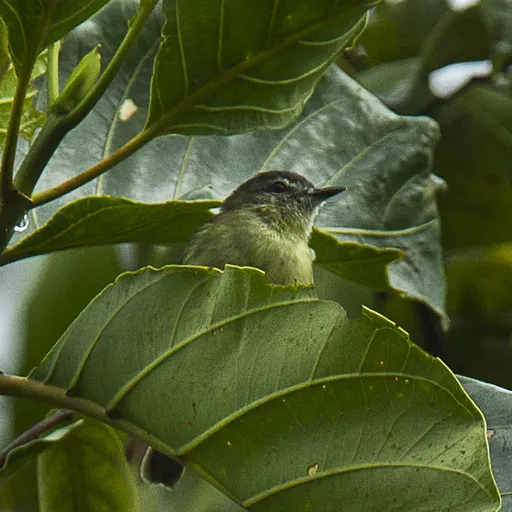
Ecuadorian Tyrannulet
Phylloscartes gualaquizae
Least Concern
Listen
XC249583 · Niels Krabbe · Pastaza: Churunalpi, 5 km N Canelos, Ecuador · CC BY-SA 4.0
Overview
The Ecuadorian tyrannulet (Phylloscartes gualaquizae) is a species of bird in the family Tyrannidae, commonly known as the tyrant flycatchers. It is a monotypic species that inhabits humid montane forests across Colombia, Ecuador, and Peru.
Identification
- Approximately 11.5 cm in length with a mass of around 8 g.
- Plumage features a grey crown, olive upperparts, and yellow underparts with an olive wash on the breast.
- Face has an indistinct whitish supercilium and eye-ring, with a blackish line around the ear coverts.
- Two pale yellow wing bars are formed by the tips of the wing coverts, and flight feathers have pale yellow edges and tips.
- Song is a spitting, almost rattled trill that descends, ascends, and descends again; calls include a thin 'feeee' and high 'teep' notes.
Habitat
This species inhabits humid montane forest, typically occurring in the canopy or on the forest edges. It has a disjunct distribution, with one population found along the eastern slope of the Andes in southwestern Colombia, Ecuador, and possibly northwestern Peru, and another in the upper Mayo River valley near the border of Peru's San Martín and Amazonas departments.
Diet
The diet consists mostly of arthropods, though specific details are lacking. The bird forages actively in the forest canopy, usually 10 to 30 m above the ground, by perching on branches and making short sallies to grab or hover-glean prey from leaves and twigs. It typically forages singly, in pairs, or as part of a mixed-species feeding flock.
Did you know?
The species' scientific name, gualaquizae, is derived from Gualaquiza Canton in Ecuador, where the type specimen was collected. Its IUCN Red List status has fluctuated over time, moving from Least Concern in 2004 to Near Threatened in 2012, and back to Least Concern in 2023.
Sources
- Wikipedia · CC BY-SA 4.0
- Wikidata · CC0 1.0