
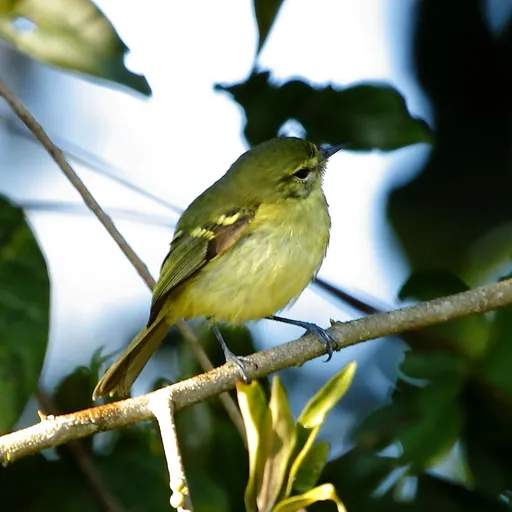
Restinga Tyrannulet
Phylloscartes kronei
Least Concern
Overview
The restinga tyrannulet (Phylloscartes kronei) is a small bird in the tyrant flycatcher family that is endemic to southeastern Brazil. Classified as Least Concern by the IUCN, it is a year-round resident that occupies a narrow coastal band, although its population is believed to be decreasing due to habitat loss.
Identification
- Approximately 12 cm long with a greenish olive upper body that is slightly browner on the crown.
- Yellow supercilium and broken eye-ring, with a dusky line sweeping around mottled dusky and yellowish ear coverts.
- Medium yellow underparts that are brightest on the belly, with faint greenish mottling on the breast and flanks.
- Song described as a very high, fast, twittering series, transcribed as sit-it-it-it-it-it-it-it-it-it-sitit-sitit.
Habitat
Found along a narrow coastal band in southeastern Brazil, from the Ribeira River floodplain in São Paulo to northeastern Rio Grande do Sul. It primarily inhabits restinga, which consists of low-stature woodlands on coastal sand ridges, and also uses adjacent evergreen, secondary, and riverside forests near sea level.
Diet
The species feeds primarily on arthropods and occasionally consumes fruit. It forages actively in the understory up to 15 m above the ground, typically perching on sloping branches to make short sallies for prey. It usually forages alone or in pairs, rarely joining mixed-species flocks.
Did you know?
The first known specimen of this bird was collected in 1898 but was misidentified as a mottle-cheeked tyrannulet, an error that was not corrected until the species was formally described later.
Sources
- Wikipedia · CC BY-SA 4.0
- Wikidata · CC0 1.0