
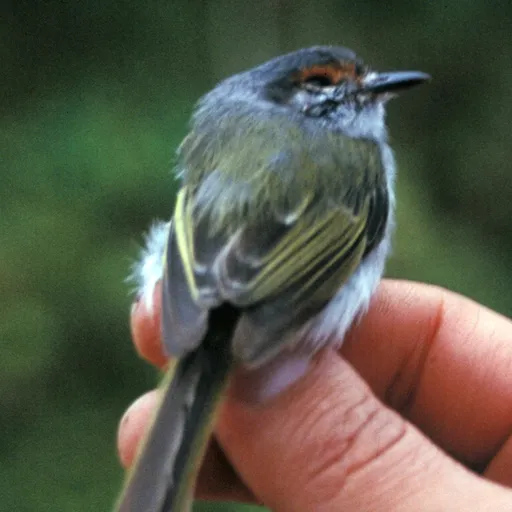
Rufous-browed Tyrannulet
Phylloscartes superciliaris
Least Concern
Listen
XC249791 · Niels Krabbe · Morona-Santiago: w-slope Cord. de Cutucú, Ecuador · CC BY-SA 4.0
Overview
The rufous-browed tyrannulet, Phylloscartes superciliaris, is a small species of tyrant flycatcher found in the subtropical and tropical zones of the Americas. It is classified as Least Concern by the IUCN, though its population is believed to be decreasing.
Identification
- Length 9.5 to 12 cm with a weight of 7 to 9 g, featuring a pearly gray crown and bright olive upperparts.
- Bright chestnut forecrown and lores extending into a thin supercilium, accompanied by a small white spot at the base of the bill.
- White ear coverts with a thin but conspicuous black border, set against a grizzled whitish face.
- Underparts are white with yellowish green tinges on the flanks and a yellowish tinge on the belly and undertail coverts.
Habitat
This species inhabits the canopy and edges of humid and wet montane evergreen forest, ranging from 500 to 2,200 m in elevation depending on the region. Its distribution is disjunct across Costa Rica, Panama, Colombia, Venezuela, Ecuador, and possibly Peru.
Diet
While its diet is not fully detailed, it is thought to consist primarily of insects and small fruits. It forages actively, usually singly or in small groups, by perching horizontally and making short sallies to hover-glean prey from leaves and twigs.
Did you know?
Despite being assessed as Least Concern, the rufous-browed tyrannulet is described as 'local and enigmatic' in Colombia and 'quite uncommon' in Costa Rica, even though it is considered locally fairly common in Peru.
Sources
- Wikipedia · CC BY-SA 4.0
- Wikidata · CC0 1.0