
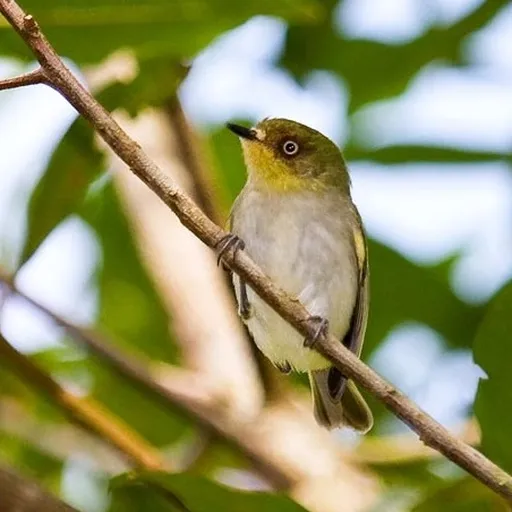
Bay-ringed Tyrannulet
Phylloscartes sylviolus
Least Concern
Overview
The bay-ringed tyrannulet is a species of bird in the family Tyrannidae, the tyrant flycatchers. It is currently classified as Least Concern on the IUCN Red List, although its population is believed to be decreasing due to habitat loss. This monotypic species is found in South America, specifically in Argentina, Brazil, and Paraguay.
Identification
- Approximately 12 cm long, with rufous-chestnut lores extending to a wide eye-ring.
- Upperparts are bright olive, while the lower face is pale yellow and underparts are mostly whitish with a greenish dusky tinge on the sides.
- Features a bright white iris, a pointed black bill, and bluish gray to slate legs.
- Song consists of a rapid, almost level twittering simplified as 'twitwi--twididirit-tjutju', with extremely high 'twi' notes and a descending, low-pitched 'tjutju'.
Habitat
Found in southeastern Brazil from southern Minas Gerais and Espírito Santo south to Santa Catarina, and extending west into eastern Paraguay and northeastern Argentina's Misiones Province. It inhabits the interior and edges of humid evergreen forest in lowlands and foothills, ranging in elevation from sea level to 600 m. The bird is a year-round resident in these areas.
Diet
The bay-ringed tyrannulet feeds primarily on insects and occasionally includes small fruits in its diet. It forages actively in the forest's canopy, typically perching horizontally on a branch with its tail cocked up to make short sallies or hover-glean prey from leaves and twigs. Foraging is usually done singly, in pairs, in small family groups, or as part of mixed-species feeding flocks.
Did you know?
Both parents construct the nest, which is a bag made mostly of moss with a side entrance that hangs from a horizontal branch, typically positioned between 10 and 25 m above the ground.
Sources
- Wikipedia · CC BY-SA 4.0
- Wikidata · CC0 1.0