
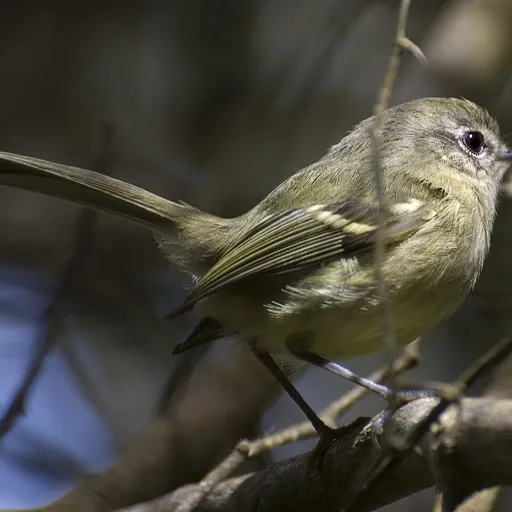
Mottle-cheeked Tyrannulet
Phylloscartes ventralis
Least Concern
Overview
The mottle-cheeked tyrannulet is a generally common, small bird belonging to the family Tyrannidae. It is found across a wide range in South America, including Argentina, Bolivia, Brazil, Paraguay, Peru, and Uruguay.
Identification
- Measures approximately 12 cm long and weighs around 9 g.
- Features a short, thin whitish supercilium, an indistinct broken whitish eye-ring, and a dusky line through the eye.
- Displays eponymous whitish and dusky mottled cheeks, a dusky "moustache", and a wide whitish and dusky crescent below the eye.
- Possesses a long, flat, pointed black bill with a pinkish to yellowish base, and slate to bluish gray legs.
Habitat
This species has a disjunct distribution, inhabiting montane evergreen forest, higher ridgetop cloudforest, and lower tropical forest in the Andes between 1,000 and 2,400 m in elevation. In Brazil, Paraguay, Uruguay, and northeastern Argentina, it occurs in montane, tropical, gallery, and temperate forests dominated by Araucaria or Podocarpus, mostly found below 1,500 m.
Diet
The mottle-cheeked tyrannulet feeds mostly on arthropods and includes a few fruits in its diet. It forages actively from the mid-story to the canopy, sometimes lower in dense understory, by perching horizontally and making short sallies to grab or hover-glean prey from leaves and twigs. It typically forages singly or in pairs, and sometimes joins mixed-species feeding flocks.
Did you know?
Nests of subspecies P. v. angustirostris are made entirely of "Spanish moss" (Tillandsia usneoides), whereas nests of P. v. tucumanus are balls made from a mix of plant fibers, dead leaves, lichen, and moss.
Sources
- Wikipedia · CC BY-SA 4.0
- Wikidata · CC0 1.0