
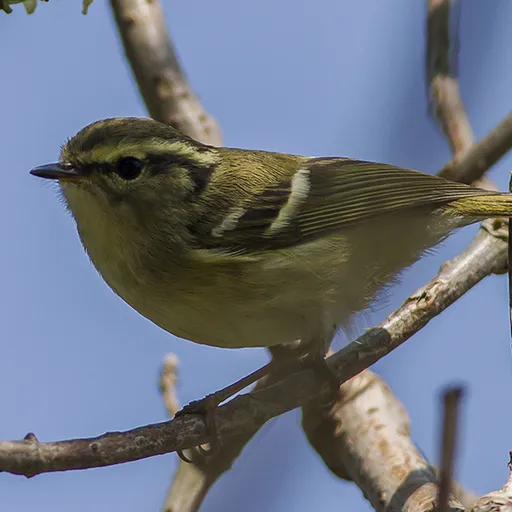
Lemon-rumped Warbler
Phylloscopus chloronotus
Least Concern
Overview
The Lemon-rumped Warbler (Phylloscopus chloronotus), also known as the Pale-rumped Warbler, is a small Old World warbler native to the Himalayas. It is assessed as Least Concern by the IUCN due to its widespread distribution and stable populations across montane forests.
Identification
- 9–10 cm long with a weight of 4.6–5.1 g, featuring greenish-grey upperparts and a yellowish or whitish rump.
- Distinctive head markings include a whitish crown stripe bordered by olive-brown sides, a pale supercilium, and a dark eyestripe that often curves downward.
- The bill is dark with a yellowish or orange base to the lower mandible, while the legs are dark grey.
- Vocalisations consist of two song types: a short trill followed by a lower trill, and a longer, varied series of notes; the call is a sharp, high 'pist' or 'psit.'
Habitat
Breeding in montane forests between 2 200 and 4 200 metres above sea level, the species inhabits spruce and fir forests mixed with rhododendron, oak, and broadleaf trees. In winter, it descends to lower elevations ranging from 300 to 2 700 metres, generally above 1 000 metres, in the southern foothills and the Purvanchal Range.
Diet
The diet consists mainly of insects and larvae, which the bird catches through foraging in the canopy and understory. It frequently engages in flycatching, involving short hovering or sallies to capture prey in the air, and may forage alone, in pairs, or in mixed-species flocks.
Did you know?
The Lemon-rumped Warbler was once classified as a subspecies of the Sichuan Leaf Warbler, but its status as a distinct species was only confirmed after vocal and genetic studies revealed differences between the two.
Sources
- Wikipedia · CC BY-SA 4.0
- Wikidata · CC0 1.0