
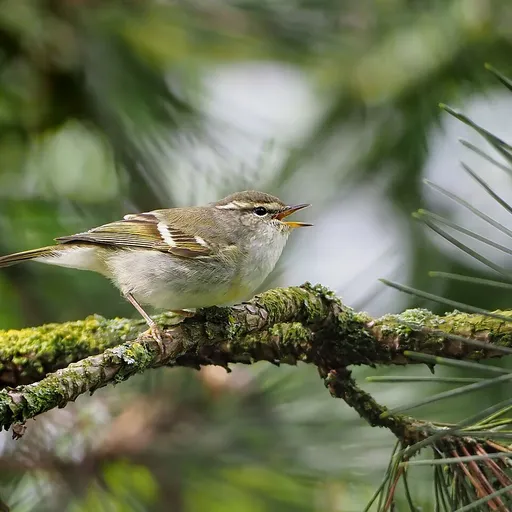
Yellow-browed Warbler
Phylloscopus inornatus
Least Concern
Listen
XC776641 · Sonothèque ADVL · Carolles, Manche, Normandie, France · CC0 1.0
Overview
The yellow-browed warbler (Phylloscopus inornatus) is a small leaf warbler that breeds in the east Palearctic and winters primarily in tropical South and South-east Asia. As a strongly migratory species, it is classified as Least Concern on the IUCN Red List due to its wide range and stable population.
Identification
- 9.5–11 cm long and 4–9 g in weight, making it distinctly smaller than a chiffchaff but slightly larger than Pallas's leaf warbler.
- Greenish upperparts and white underparts with a long yellow supercilium and prominent double wing bars formed by yellowish-white tips on the wing coverts.
- Some individuals display a faint paler green central crown stripe, though many do not.
- Piercing, often disyllabic 'tseeweest' call and a high-pitched song medley of whistles.
Habitat
An abundant resident of lowland and montane forests and woodlands, with a breeding range extending from west of the Ural Mountains to eastern Siberia, Mongolia, and Northeast China. It winters in lowland broadleaf or coniferous forests from northeastern India through southern China to the Malay Peninsula, though small numbers regularly winter in western Europe.
Diet
Like most warblers, it is insectivorous. The nest is typically built in dense vegetation at the base of a tree or old stump, where two to four eggs are laid.
Did you know?
Small numbers of these birds undertake a remarkably shorter 3,000–3,500 km migration to winter in Great Britain, taking advantage of the mild oceanic climate, compared to the 5,500–6,000 km journey required to reach their traditional wintering grounds in South-east Asia.
Sources
- Wikipedia · CC BY-SA 4.0
- Wikidata · CC0 1.0