
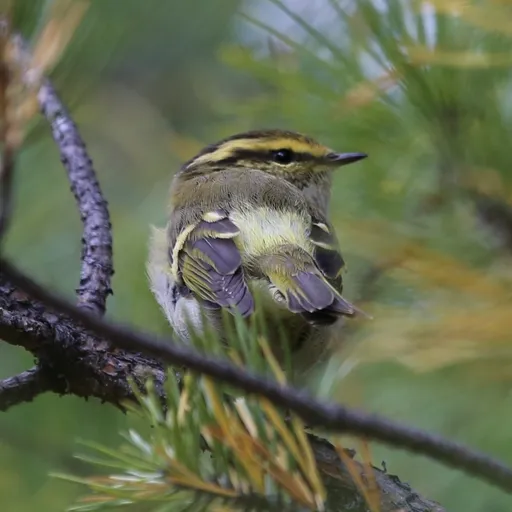
Pallas's Leaf Warbler
Phylloscopus proregulus
Least Concern
Listen
XC707368 · Sonothèque ADVL · Beauvoir, Manche, Normandie, France · CC0 1.0
Overview
Pallas's leaf warbler is a small, strongly migratory bird that breeds in mountain forests across southern Siberia, northern Mongolia and northeast China. It winters primarily in subtropical south China and adjacent areas of southeast Asia, though increasing numbers are now recorded in Europe. The species is named after the German zoologist Peter Simon Pallas, who first formally described it.
Identification
- One of the smallest Palearctic warblers, measuring 9–10 cm in length with a relatively large head and short tail.
- Greenish upperparts and white underparts, highlighted by a lemon-yellow rump, yellow double wingbars, bold yellow supercilia and a central crown stripe.
- Bill is blackish-brown with yellowish tinges; legs are brown with a green or greyish tinge.
- Song is a strong, prolonged medley of whistles and trills lasting 2–4 seconds, while the call is a short, soft 'dju-ee'.
Habitat
Breeds in coniferous taiga forests containing fir, spruce, pine and larch, or mixed forests with willow and alder, ranging from sea level to 1,500–1,700 metres in southern and far-eastern Russia. In winter, it occupies a wider range of habitats including broadleaf forest, scrub and river valleys down to sea level. The species has a large breeding range spanning Siberia to northeast China, and winters mainly in south China, northern Thailand and northeastern Indochina.
Diet
This insectivorous bird feeds on the adults, larvae and pupae of small insects such as flies, moths and aphids, as well as spiders. Foraging takes place in bushes and trees, where the bird picks items from leaves or catches prey in short flights or while hovering. When not breeding, it may join mixed-species foraging flocks containing tits, goldcrests and other warblers.
Did you know?
The English name of the species commemorates Peter Simon Pallas, who discovered the bird on the Ingoda River in Siberia in May 1772. It is also a host of the oriental cuckoo, a brood parasite whose egg is similar in appearance, though larger, to those of the warbler.
Sources
- Wikipedia · CC BY-SA 4.0
- Wikidata · CC0 1.0