
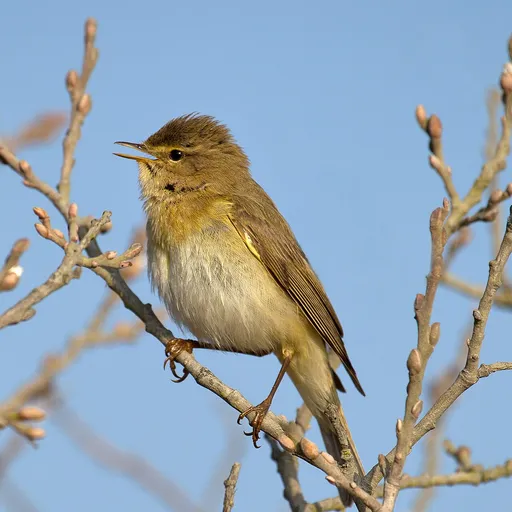
Willow Warbler
Phylloscopus trochilus
Least Concern
Listen
XC730600 · Sonothèque ADVL · La Lucerne-d'Outremer, Manche, Normandie, France · CC0 1.0
Overview
The willow warbler (Phylloscopus trochilus) is a very common and widespread leaf warbler that breeds throughout northern and temperate Europe and the Palearctic. It is a strongly migratory species, with almost the entire population wintering in sub-Saharan Africa.
Identification
- Plumage and size: 11–12.5 cm long, greenish brown above and off-white to yellowish below; wings are plain greenish-brown with no wingbars.
- Legs and bill: Distinguished from the similar chiffchaff by paler pinkish-yellow legs, a longer paler bill, and a longer primary projection.
- Song and call: Song is a simple repetitive descending whistle; contact call is a disyllabic 'hoo-eet'.
Habitat
Favours young, open, and scrubby woodland with small trees, particularly birch, alder, and willow, often near water features like streams. It prefers damp areas with ground cover such as bramble, bracken, and mosses, and will also use open coniferous forests. Its breeding range extends from Ireland east to the Anadyr River basin in eastern Siberia.
Diet
As a typical Old World warbler, it is insectivorous. Specific foraging behaviours are not detailed in the provided reference material.
Did you know?
Despite its small size, the subspecies P. t. yakutensis performs one of the longest migrations of any animal, travelling up to 12,000 km from eastern Siberia to southern Africa.
Sources
- Wikipedia · CC BY-SA 4.0
- Wikidata · CC0 1.0