
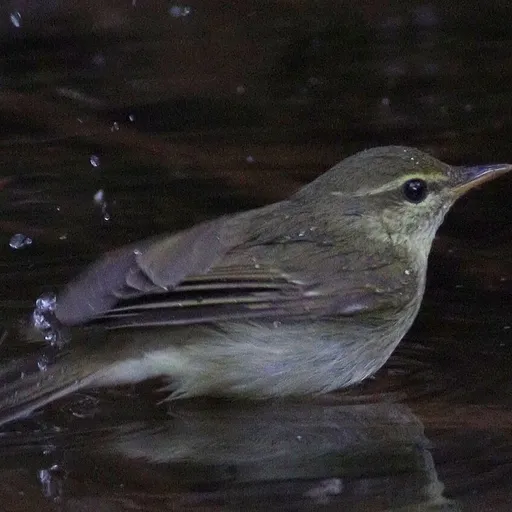
Japanese Leaf Warbler
Phylloscopus xanthodryas
Least Concern
Overview
The Japanese leaf warbler (Phylloscopus xanthodryas) is a small migratory bird in the family Phylloscopidae, first described in 1863. It breeds throughout Japan, excluding Hokkaido, and winters in Southeast Asia. The species is classified as Least Concern on the IUCN Red List with a stable population trend.
Identification
- Length between 12 and 13 cm with bright olive-green plumage on adults, featuring a white wingbar and greenish tail.
- Dark green upperparts and lighter green underparts, accompanied by a clear yellowish-white eyebrow stripe above dark eyes.
- Very short black beak with a hint of yellow and extremely small legs ranging from pale yellow to orange-brown.
- Song consists of short phrases repeated for 1.5 to 2 seconds, lower in pitch and slower in rhythm than related species, with a dry 'brrt' call.
Habitat
This species inhabits mixed and deciduous forests, coniferous woods, and thickets, typically between 1500 and 2500 meters elevation. It nests in thick undergrowth, rhododendron bushes, and scrub above the tree line, but uses lower elevations below 1800 meters during winter. It depends on thick vegetation for both nesting and foraging across its breeding range in Honshu and Kyushu, and its wintering grounds in Southeast Asia.
Diet
The diet consists mainly of insects and their larvae, including midges, ants, grasshoppers, caterpillars, beetles, spiders, and small snails, with berries consumed in autumn. It forages alone or in pairs, sometimes joining mixed flocks outside the breeding season, and searches for food in trees, shrubs, on the ground, and occasionally in flight.
Did you know?
Nests are frequently targeted by cuckoos, which lay their eggs inside the warbler's nest, and snakes may also prey on them. Both parents usually feed the young, although the female sometimes cares for them alone.
Sources
- Wikipedia · CC BY-SA 4.0
- Wikidata · CC0 1.0