
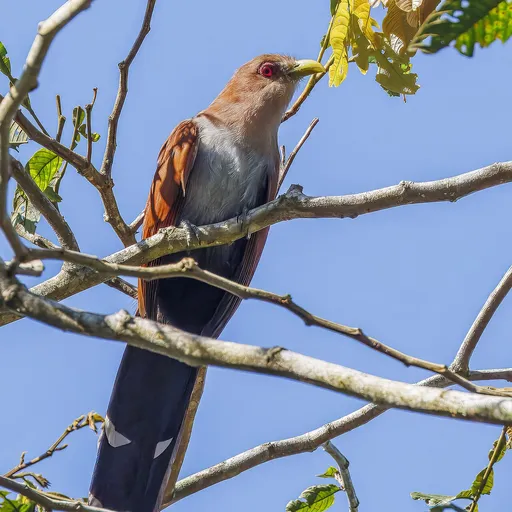
Squirrel Cuckoo
Piaya cayana
Least Concern
Overview
The squirrel cuckoo (Piaya cayana) is a large and active cuckoo species found in wooded habitats from northwestern Mexico to northern Argentina and Uruguay, as well as on Trinidad. It derives its English name from its habit of running along branches and leaping from one to another like a squirrel, usually flying only short gliding distances. The species is classified as Least Concern by the IUCN and is plentiful throughout its wide range.
Identification
- Length of 40.5–50 cm with an extremely long tail; adults have chestnut upperparts and head, a grey lower breast, and a blackish belly.
- Yellow bill with red irises in adults, contrasting with the grey bill, brown irises, and less white tail found in immatures.
- Central tail feathers are rufous, while outer tail feathers are black with white tips, though some subspecies show brown outer tail feathers instead.
- Makes explosive 'kip! kip! weeuu' calls and a whistled 'wheep wheep wheep wheep' song.
Habitat
Found in woodland canopies and edges, second growth, hedges, and semi-open habitats from sea level up to 2,500 m, although it is uncommon above 1,200 m. The species is present from northwestern Mexico to northern Argentina and Uruguay, including Trinidad, and is quite tolerant of human disturbance provided woodland remains.
Diet
Feeds primarily on large insects such as cicadas, wasps, and caterpillars, including those with stinging hairs or spines, and occasionally consumes spiders, small amphibians, and reptiles. Non-flying prey is typically taken off foliage with a quick lunge, while wasps may be caught on the wing, and the bird occasionally takes fruit.
Did you know?
Squirrel cuckoos are often observed foraging peacefully alongside small mammals such as common marmosets during the dry season for cocoa beans. They also frequently attend army ant columns to pick off prey flushed by the ants.
Sources
- Wikipedia · CC BY-SA 4.0
- Wikidata · CC0 1.0