
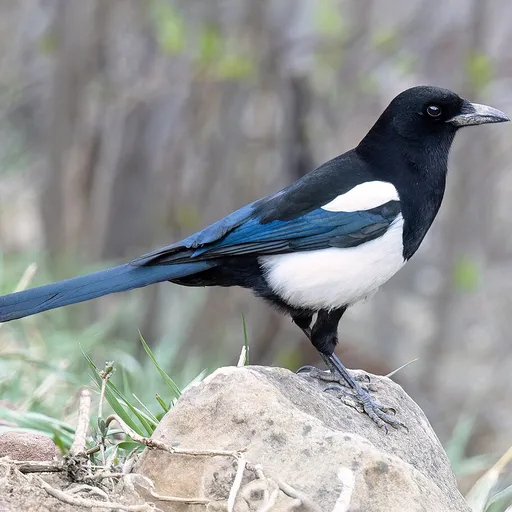
Black-billed Magpie
Pica hudsonia
Least Concern
Listen
XC254489 · Jonathon Jongsma · Oak Draw Rd, Custer State Park, South Dakota, United States · CC BY-SA 4.0
Overview
The black-billed magpie (Pica hudsonia), also known as the American magpie, is a medium-sized bird in the corvid family found in the western half of North America. It was formerly treated as a subspecies of the Eurasian magpie but was recognised as a separate species in 2000 based on genetic studies and differing vocalisations.
Identification
- Measures 45–60 cm (18–24 in) in length and is largely black with white scapulars, belly, and primaries.
- Wings and tail display iridescent hints of blue and blue-green, with a long tail where the middle feathers extend further than the rest.
- Possesses a uniformly black, oblong, weakly curved bill and black irises in adults.
- Vocalisations include various tweets, coos, and squawks, with a common alarm call described as a ka-ka-ka-ka chatter.
Habitat
Ranging from coastal southern Alaska and Canada down through the Rocky Mountains to northern Minnesota and Iowa, this non-migratory species prefers open habitats with clumps of trees, meadows, and suburbs. During the breeding season, it favours riparian areas with thickets, while outside of breeding it is also found near feedlots, landfills, and human dwellings.
Diet
As an opportunistic omnivore, it consumes carrion, insects, seeds, berries, nuts, and occasionally small vertebrates or eggs. The bird primarily forages on the ground by scratching to turn over litter, and it frequently follows large predators to scavenge or lands on large mammals to pick ticks.
Did you know?
Black-billed magpies are the only North American corvids that build nests with domes, often constructing a loose hood over the nest cup. They also gather excitedly in trees near the body of a dead conspecific in a poorly understood behaviour known as a funeral.
Sources
- Wikipedia · CC BY-SA 4.0
- Wikidata · CC0 1.0