
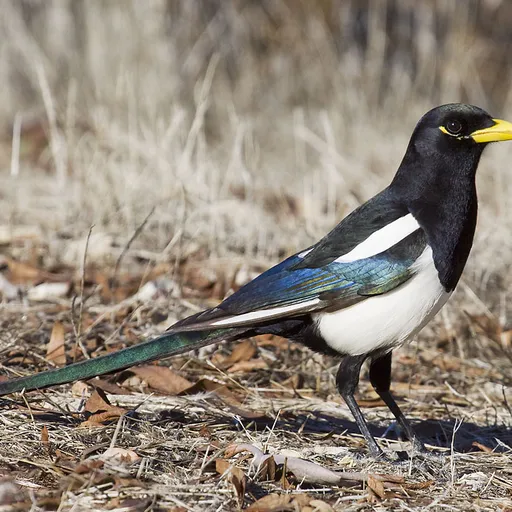
Yellow-billed Magpie
Pica nuttalli
Overview
The yellow-billed magpie, also known as the California magpie, is a medium-sized corvid that is endemic to California's Central Valley and the adjacent chaparral foothills and mountains. It is virtually identical to the black-billed magpie found in much of the rest of western North America, apart from having a yellow bill, a yellow streak around the eye, and being slightly smaller.
Identification
- Medium-sized corvid measuring 43–54 centimeters in length, slightly smaller on average than the black-billed magpie.
- Pied plumage featuring a black head, back, wings, and tail with a white belly and shoulders; black feathering is glossed iridescent, reflecting green, blue, purple, or bronzed in good light.
- Bright yellow bill accompanied by a small patch of yellow bare skin around the eyes, with black eyes and legs.
- White inner vanes on the wing primary feathers are visible as a white outer wing patch in flight but not when perched.
- Calls are similar to those of the black-billed magpie but marginally higher-pitched.
Habitat
This species is endemic to California's Central Valley and the adjacent chaparral foothills and mountains, where it is a permanent resident that does not usually wander far outside its breeding range. It prefers groves of tall trees along rivers and near open areas, though it has begun nesting in vacant lots and weedy places in some cities. The IUCN classifies the bird as a vulnerable species due to habitat loss and other threats, yet it remains widespread and common in many places within its limited distribution.
Diet
These omnivorous birds forage on the ground, primarily eating insects such as grasshoppers, but also consuming carrion, acorns, and fruit in the fall and winter. They are attracted to recently butchered carcasses on farms and ranches, pick through garbage at landfills and dumping sites, and sometimes hunt rodents.
Did you know?
Yellow-billed magpie flocks engage in funeral-like behavior for their dead, gathering around a deceased bird and calling out loudly for 10 to 15 minutes. Additionally, the species is extremely susceptible to West Nile virus, with an estimated 50% of all yellow-billed magpies dying from the infection between 2004 and 2006.