
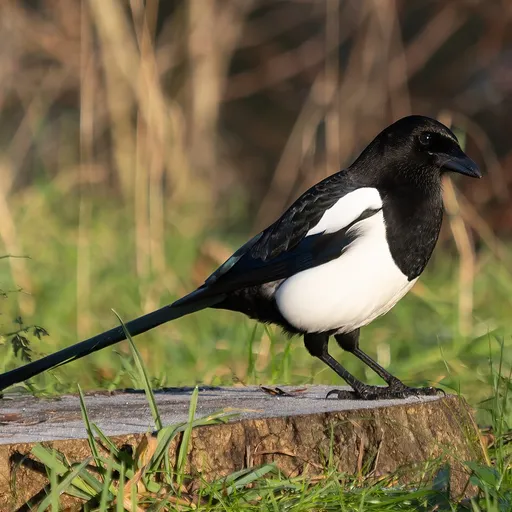
Eurasian Magpie
Pica pica
Least Concern
Listen
XC1148526 · Philippe_Grange · Arrondissement de la Roche-sur-Yon (near La Roche-sur-Yon), Vendée, Pays de la Loire, France · CC0 1.0
Overview
The Eurasian magpie, or common magpie (Pica pica), is a resident breeding bird throughout the northern part of the Eurasian continent. It is a member of the crow family, specifically designated as one of the 'monochrome' magpies in the Holarctic radiation. The species is classified by the International Union for Conservation of Nature as being of Least Concern.
Identification
- Adult males of the nominate subspecies measure 44–46 cm in length, with more than half of that length comprising the graduated tail.
- The head, neck, breast, and vent feature a glossy black plumage with a metallic green and violet sheen, contrasted by a pure white belly and scapulars.
- Wings are black with green or purple gloss and conspicuous white inner webs, while the legs, bill, and graduated tail are black with the same metallic sheen.
- The call is distinctive, described as a choking chatter of 'chac-chac' or repetitive 'chac-chac-chac-chac', while young may also produce an acute 'Uik Uik' sound resembling the barking of a small dog.
Habitat
The range extends across temperate Eurasia from Portugal, Spain, and Ireland in the west to the Kamchatka Peninsula in the east. The species prefers open countryside with scattered trees, as it is normally absent from treeless areas and dense forests. They sometimes breed at high densities in suburban areas, parks, and gardens, and can often be found close to city centres.
Diet
The Eurasian magpie is omnivorous, consuming a varied diet that includes young birds, eggs, small mammals, insects, scraps, carrion, acorns, grain, and other vegetable substances. In the wild, they organise themselves into gangs and use complex strategies to hunt other birds and fend off potential predators.
Did you know?
The Eurasian magpie is one of the few bird species known to pass the mirror test, demonstrating self-recognition. Its nidopallium is approximately the same relative size as those in chimpanzees, gorillas, orangutans, and humans, with a total brain-to-body mass ratio equal to that of most great apes and cetaceans.
Sources
- Wikipedia · CC BY-SA 4.0
- Wikidata · CC0 1.0