
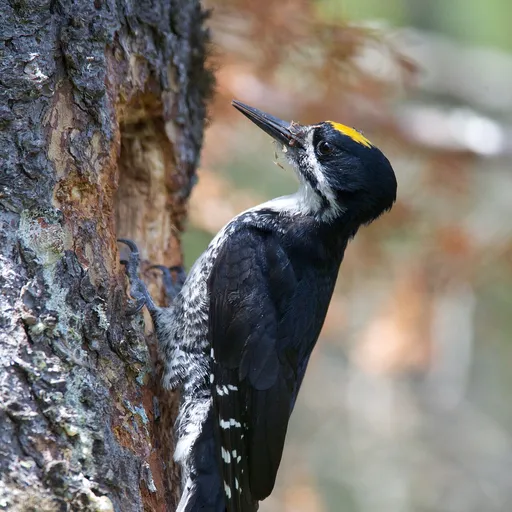
Black-backed Woodpecker
Picoides arcticus
Least Concern
Listen
XC461334 · Justin Watts · Sax-Zim Bog, St. Louis Co., Minnesota, United States · CC BY-SA 4.0
Overview
The black-backed woodpecker, also known as the Arctic three-toed woodpecker, is a medium-sized woodpecker inhabiting the forests of North America. Classified as Picoides arcticus, it is currently listed as Least Concern on the IUCN Red List.
Identification
- Adults feature black plumage on the head, back, wings, and rump, with white throats and bellies; flanks are white with black bars.
- The tail is black with white outer feathers, and adult males possess a distinct yellow cap.
- Measuring 23 cm in length, this species notably possesses three-toed feet, distinguishing it from most other true woodpeckers.
- The call note is a single, sharp pik that is lower pitched than the call of the American three-toed woodpecker.
Habitat
The breeding range encompasses boreal forests across Canada, Alaska, and the northwestern United States, extending to specific areas in northern Wisconsin, the Adirondacks in New York, New England, Minnesota, and Upper Michigan. The species is particularly associated with burnt-forest habitats where it thrives on recently burnt trees.
Diet
This species is a specialist in feeding on wood-boring beetles, particularly those from the families Cerambycidae and Buprestidae, along with engraver beetles and the mountain pine beetle. Most food is obtained by pecking, while a smaller proportion is gleaned from branches.
Did you know?
Unlike all other true woodpeckers except the related American and Eurasian three-toed woodpeckers, the black-backed woodpecker has three-toed feet.
Sources
- Wikipedia · CC BY-SA 4.0
- Wikidata · CC0 1.0