
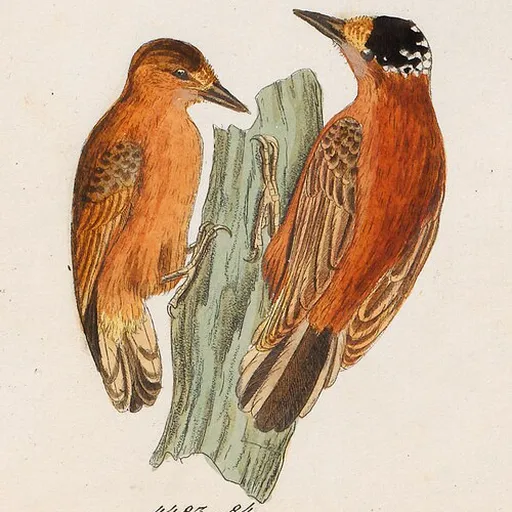
Chestnut Piculet
Picumnus cinnamomeus
Least Concern
Overview
The chestnut piculet (Picumnus cinnamomeus) is a small woodpecker found in Colombia and Venezuela. It is classified as a species of Least Concern by the IUCN, although its population size and trend remain unknown.
Identification
- Measures 9 to 10 cm in length with a blackish beak and brown iris.
- Males feature a pale creamy forehead, a black crown with yellow-tipped feathers, and a black nape with white-tipped feathers; females lack the yellow crown and have restricted white spotting.
- Body plumage is deep rufous to rusty brown, with wings edged in cinnamon or rufous and a brownish-black tail.
- Song consists of 3 to 8 high-pitched notes, described as 'ti.ti.ti.ti.ti', descending in pitch.
Habitat
Found in a wide variety of landscapes including rainforest, deciduous forest, open areas with scattered trees, arid and semi-arid scrublands, mangroves, and coffee plantations, with a preference for thorny woodlands. It occurs from sea level up to 100 m in Venezuela and 300 m in Colombia.
Diet
The species forages actively at all levels of its habitat but tends to stay in dense vegetation, typically seen singly, in pairs, in small family groups, or in mixed-species foraging flocks. Its diet is assumed to consist of ants and other small insects, although it has not been formally studied.
Did you know?
Despite not being as inconspicuous as most other piculets, the chestnut piculet remains rather poorly known and has few records in Venezuela.
Sources
- Wikipedia · CC BY-SA 4.0
- Wikidata · CC0 1.0