
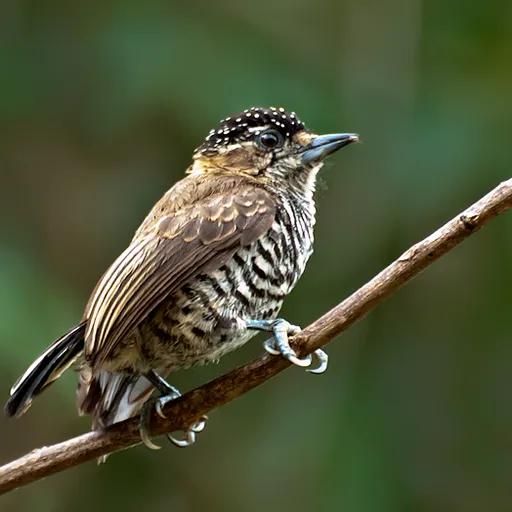
White-barred Piculet
Picumnus cirratus
Least Concern
Overview
The white-barred piculet (Picumnus cirratus) is a small woodpecker found across parts of South America, including Argentina, Bolivia, Brazil, French Guiana, Guyana, Paraguay, and Uruguay. It is classified as Least Concern on the IUCN Red List, though it faces local threats from the deterioration of remnant forest habitat in urban areas.
Identification
- Approximately 10 cm (3.9 in) long and weighs between 6.3 and 12 g.
- Males of the nominate subspecies have a black cap with a red forehead patch and white spots, while females lack the red on the forehead.
- Dull brownish upperparts with dark brown flight feathers that have buffish-white edges on the secondaries and tertials.
- Underparts are white with black barring and a buff tinge on the belly and flanks; the beak is black with a pale base to the mandible.
- Vocalisations include a high, dry, fast trill like 'trrrrriut' and a 'tsirit, tsick' call, alongside loud staccato drumming on dead wood.
Habitat
This species inhabits a variety of landscapes, including wet and dry woodland, forest edges, thickets, gallery forest in savannah, scrub, bamboo clumps, várzea, and overgrown parks and gardens. Its elevation range extends from near sea level to approximately 2,100 m (6,900 ft).
Diet
The white-barred piculet forages singly or in small mixed-species flocks, feeding on ants, insect larvae, eggs of wood-boring beetles, and other small invertebrates. It actively drills holes in wood and may consume sap oozing from puncture marks, feeding primarily on twigs and branch tips, as well as vines and bamboo, sometimes clinging to the underside of branches.
Did you know?
The specific epithet cirratus derives from the Latin word for a ringlet or curl, meaning 'curly headed'. The bird is also known to hybridise widely with several other piculet species where their ranges overlap, including the varzea, ochre-collared, ocellated, and white-wedged piculets.
Sources
- Wikipedia · CC BY-SA 4.0
- Wikidata · CC0 1.0