
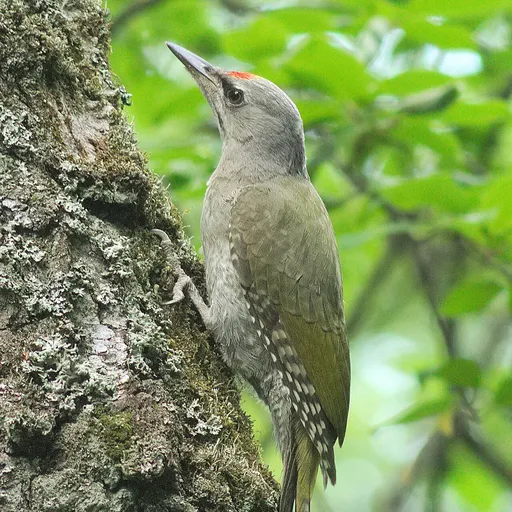
Grey-headed Woodpecker
Picus canus
Least Concern
Listen
XC710232 · Camille Vacher · Arrondissement de Montbard (near Villiers-le-Duc), Côte-d'Or, Bourgogne-Franche-Comté, France · CC BY 4.0
Overview
The grey-headed woodpecker (Picus canus), also known as the grey-faced woodpecker, is a Eurasian bird and one of three closely related green woodpecker species in Europe. It is classified as Least Concern on the IUCN Red List, though its populations are generally in decline.
Identification
- Size: Approximately 25–26 cm in length, with a wingspan of 38–40 cm, resembling the size of a Eurasian collared dove.
- Plumage: Grey head transitioning to olive green upperparts and pale grey underparts; males have a red forecrown, while females have fine black streaks on the crown.
- Bill and Head: Features a shorter neck, slimmer bill, and slightly rounder head than the European green woodpecker, with a black moustache stripe.
- Song: A far-carrying, melodic call consisting of 10–15 utterances of declining pitch, often described as melancholic or 'dying', differing from the explosive laughter of the green woodpecker.
Habitat
Found across central, northern, and eastern Europe, as well as a broad belt across Asia reaching the Pacific coast and south to the Himalaya and Malay Peninsula. It prefers undisturbed deciduous forests with a high proportion of dead trees, as well as riparian forests, and is absent from the British Isles, Iberian Peninsula, and Mediterranean islands.
Diet
The diet consists primarily of ants and their immatures, which may comprise up to 90% of intake, alongside termites, caterpillars, crickets, and beetles. It forages as an intermediate ant hunter, less specialised than the European green woodpecker, and switches to including significant amounts of berries and fruit in late autumn and early winter.
Did you know?
Grey-headed woodpeckers often select metal covers on masts and roofs as drumming substrates due to their favourable resonance characteristics, sometimes using sites at a considerable distance from the nest for years.
Sources
- Wikipedia · CC BY-SA 4.0
- Wikidata · CC0 1.0