
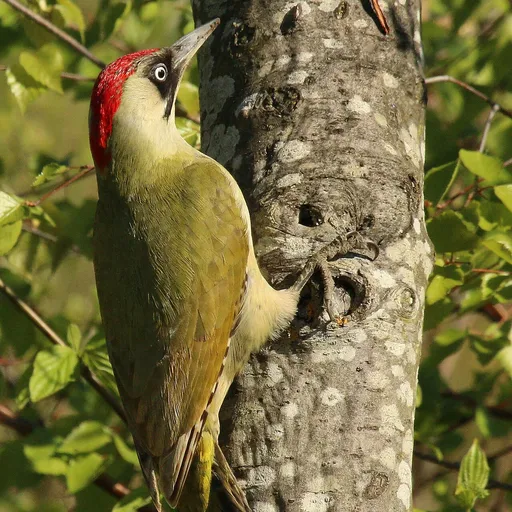
European Green Woodpecker
Picus viridis
Least Concern
Listen
XC707117 · Sonothèque ADVL · Saint-Jean-le-Thomas, Manche, Normandie, France · CC0 1.0
Overview
The European green woodpecker, also known as the yaffle, is a large, resident woodpecker found across much of Europe and the western Palearctic. It is characterised by vivid green and red plumage but remains a shy and wary bird that is more often heard than seen.
Identification
- Measures 30–36 cm in length with a wingspan of 45–51 cm, featuring green upperparts, pale yellowish green underparts, a yellow rump, and a bright red crown.
- A black moustachial stripe runs down the face, which contains a red centre in males but is solid black in females; both sexes have black lores and a white eye-ring.
- Distinctive flight is undulating, with three to four wingbeats followed by a short glide with wings held to the body.
- Produces loud calls known as 'yaffling' and a song of 10–18 'klü' sounds that speeds up and lowers in pitch; rarely drums, producing only a soft, fast roll.
Habitat
This species resides in semi-open landscapes with small woodlands, hedges, scattered old trees, and forest edges, requiring a mix of old deciduous trees for nesting and nearby grounds rich in ants. It is highly sedentary, with individuals rarely moving more than 500 m between breeding seasons, and is widely distributed across Europe, though absent from Ireland, Greenland, and parts of northern and eastern Europe.
Diet
Primarily feeds on ants of the genera Lasius and Formica, foraging on the ground by probing into nests and licking up adults and larvae with a long, sticky tongue. Occasionally consumes other insects and small reptiles, and can dig through up to 85 cm of snow to reach ant nests.
Did you know?
Seven chicks in a Romanian nest were estimated to consume 1.5 million ants and pupae before leaving the nest. Heavy snow cover can cause high mortality rates, with populations potentially taking ten years to recover from such events.
Sources
- Wikipedia · CC BY-SA 4.0
- Wikidata · CC0 1.0