
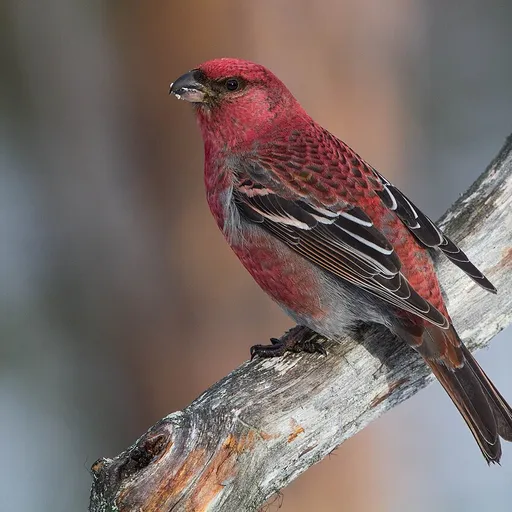
Pine Grosbeak
Pinicola enucleator
Least Concern
Listen
XC994340 · Doug Hynes · Pouch Cove Line, Newfoundland and Labrador, Canada · CC BY-SA 4.0
Overview
The pine grosbeak is a large member of the true finch family and the only species in the genus Pinicola. It is primarily found in coniferous woods across the Palearctic and North America. The species exhibits irruptive behaviour, moving long distances to the south or downslope during years when fruit crops are scarce.
Identification
- Males display a rose-red head, back, and rump, contrasting with black wings and a long, forked black tail.
- Females are olive-yellow on the head and rump, with grey backs and underparts.
- A large conical beak and black wings featuring white wing bars are visible on both sexes.
- The voice includes a whistled pui pui pui or chii-vli, while the song is described as a short musical warble.
Habitat
Pine grosbeaks reside in coniferous forests and woodlands across boreal regions of northern Eurasia and North America. They typically remain resident near their breeding grounds or migrate short distances to the southern extent of boreal forests, though they may travel further south during irruptive years. In the New World, their typical winter distribution includes the northern Great Lakes region and northern New England, and they are a very rare vagrant to temperate parts of Europe.
Diet
Pine grosbeaks forage in trees and bushes for seeds, buds, berries, and insects. They are frugivores, especially in winter, favouring small fruits such as rowans. They often feed in flocks outside of the nesting season.
Did you know?
During the breeding season, both sexes develop gular pouches that they use to store seeds before feeding them to their young.
Sources
- Wikipedia · CC BY-SA 4.0
- Wikidata · CC0 1.0