
Blue-headed Parrot
Pionus menstruus
Least Concern
Listen
Overview
The blue-headed parrot, also known as the blue-headed pionus (Pionus menstruus), is a medium-sized parrot classified as Least Concern by the IUCN Red List. It is a resident species found across tropical and subtropical regions of South and Central America.
Identification
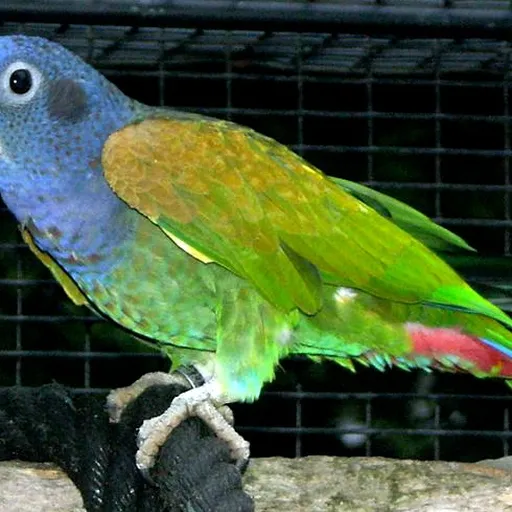
- Approximately 28 cm in length with a weight of 245 g, the body is mainly green with a blue head, neck, and upper breast.
- Distinctive red undertail coverts and some yellowish coloration on the wing coverts are visible.
- The upper mandible is black with reddish areas on both sides, and the birds possess dark ear patches.
- Juveniles have less blue on the head and red or pinkish feathers around the ceres, moulting into adult plumage between eight months and two years.
- Noisy birds that produce light, high-pitched squeaking 'sweenk' calls.
Habitat
This species inhabits forest and semi-open country, including cultivated areas, primarily within humid or semi-humid regions, though it locally extends into drier habitats along rivers. Its range spans from Costa Rica, Venezuela, and Trinidad south to Bolivia and Brazil, with specific populations found in the Amazon basin, the South Atlantic coast of Brazil, and a Pacific coastal strip from southern Ecuador to northwestern Colombia.
Diet
The blue-headed parrot feeds on fruit, flowers, and seeds, and occasionally consumes grain.
Did you know?
Despite being described as noisy in the wild with high-pitched squeaking calls, they are notably very quiet compared to other parrot species like amazons, making them popular pets, though they are not known for their talking ability.
Sources
- Wikipedia · CC BY-SA 4.0
- Wikidata · CC0 1.0