
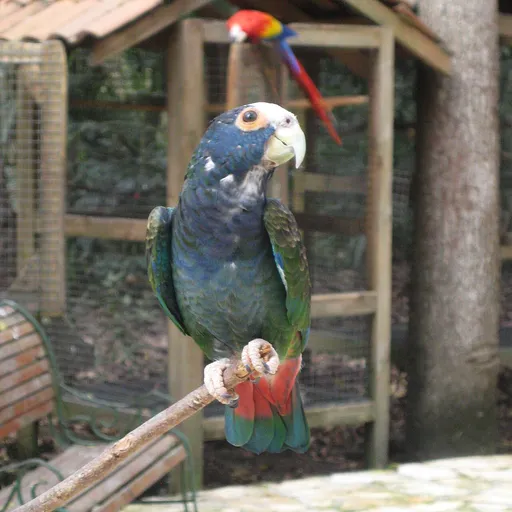
White-crowned Parrot
Pionus senilis
Least Concern
Overview
The white-crowned parrot (Pionus senilis), also known as the white-crowned pionus, is a small parrot that serves as a resident breeding species across a wide range of Central America. Classified as Least Concern on the IUCN Red List, its population remains stable despite pressures from hunting, crop damage, and the bird trade.
Identification
- 24 cm in length with a broad body and short tail, weighing approximately 220 g.
- Distinctive white forehead, crown, and throat, contrasting with dull dark blue on the head, neck, and breast.
- Light green belly and dark green upper parts, featuring a yellow-olive shoulder patch and violet-blue primary coverts.
- Loud, harsh screeching vocalisation, described as 'kreeek-kreeek', often emitted when approached, though the bird can be silent in the canopy.
Habitat
Found in lowlands and foothills up to 1600 m altitude on the Caribbean slope of Central America, ranging from southeast Mexico to western Panama. The species inhabits forest canopies and edges, adjacent semi-open woodlands, second growth, and cultivated areas with pastures and scattered trees.
Diet
Feeds in social flocks of 10–50 birds on various seeds, nuts, fruits, and palm fruits, often acting as a pest in corn, sorghum, and fruit plantations. Foraging can be unobtrusive as the birds usually remain silent within the canopy, but they may perch conspicuously at the top of unopened palm fronds when at rest.
Did you know?
The specific name senilis was given to the species because the white feathers on the male's forehead and crown resemble the white hair of an old man.
Sources
- Wikipedia · CC BY-SA 4.0
- Wikidata · CC0 1.0