
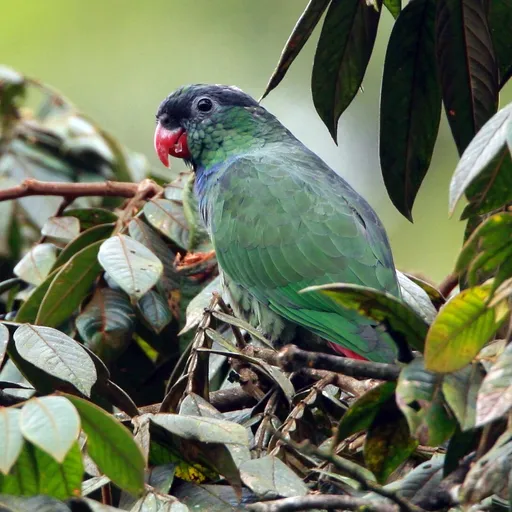
Red-billed Parrot
Pionus sordidus
Least Concern
Listen
XC251384 · Niels Krabbe · Zamora-Chinchipe: near Panguri, Ecuador · CC BY-SA 4.0
Overview
The red-billed parrot (Pionus sordidus), also known as the coral-billed or red-billed pionus, is a species of parrot in the family Psittacidae. It is classified as Least Concern by the IUCN Red List, although its population is believed to be decreasing, it remains fairly common in most of its range.
Identification
- Length 27 to 29 cm with a weight of approximately 272 g.
- Adults of the nominate subspecies possess a dull green head with dull blue feather edges, surrounded by bare grayish skin around the eye.
- Plumage includes olive green backs and wings, blue outer tail feathers, a dull blue upper breast turning buff-olive with a pink tinge on the belly, and red undertail coverts.
- Flight calls vary by subspecies: P. s. sordidus and P. s. antelius produce a strident "kee!-yak", while P. s. corallinus and P. s. mindoensis emit an upslurred "crree!" and a mellow "crrah".
Habitat
Found in a disjunct distribution across Bolivia, Colombia, Ecuador, Peru, and Venezuela, the species inhabits a variety of wooded landscapes including the interior, clearings, and edges of humid to wet lowland and submontane evergreen and semi-deciduous forests. It also occurs in cloud, secondary, and gallery forests, as well as coffee plantations, typically between 500 and 1,500 m elevation but ranging from 100 m to 2,400 m.
Diet
Little is known about the foraging behaviour of the red-billed parrot, but its diet is known to include fruits and blossoms.
Did you know?
The specific epithet sordidus is Latin for "shabby" or "dirty", while the genus name Pionus derives from the Ancient Greek piōn, pionos, meaning "fat".
Sources
- Wikipedia · CC BY-SA 4.0
- Wikidata · CC0 1.0