
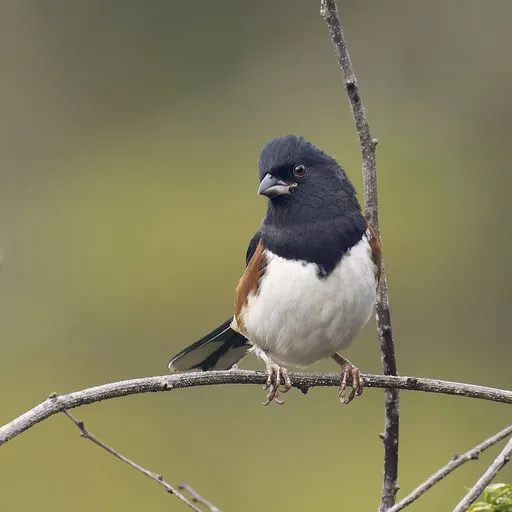
Eastern Towhee
Pipilo erythrophthalmus
Least Concern
Listen
XC320442 · Jonathon Jongsma · Afton State Park, Washington County, Minnesota, United States · CC BY-SA 4.0
Overview
The eastern towhee, Pipilo erythrophthalmus, is a large and striking New World sparrow formerly classified alongside the spotted towhee as the rufous-sided towhee. Known by several common names including chewink, joree, or joree bird, it remains listed as Least Concern on the IUCN Red List despite recent population declines along the Atlantic seaboard.
Identification
- Lengths range from 17.3 to 23 cm with a wingspan of 20–30 cm, and body mass averaging 40 g.
- Males feature a black head, upper body, and tail, while these parts are brown in females; both sexes display rufous sides and a white belly.
- Adults typically have red eyes, though southeastern populations may possess yellow eyes in the 'white-eye morph', and juveniles are brown overall.
- The song is a sharp 'drink' followed by a trilling 'teeeeea', and the call is a two-part 'chewink' that rises in pitch.
Habitat
Breeding habitats consist of brushy areas across eastern North America, including early successional stands, old-fields, and shrubby power line rights-of-way. The species ranges from near sea level to 2,000 m elevation, occurring throughout the eastern United States and southeast Canada, with northern populations migrating south for winter.
Did you know?
The specific name erythrophthalmus is derived from Ancient Greek words meaning 'red eye', referring to the eye colour of most populations, although some southeastern variants feature yellow eyes. In the rare event of range overlap with the spotted towhee in the Great Plains, hybridisation between the two species has been recorded.
Sources
- Wikipedia · CC BY-SA 4.0
- Wikidata · CC0 1.0