
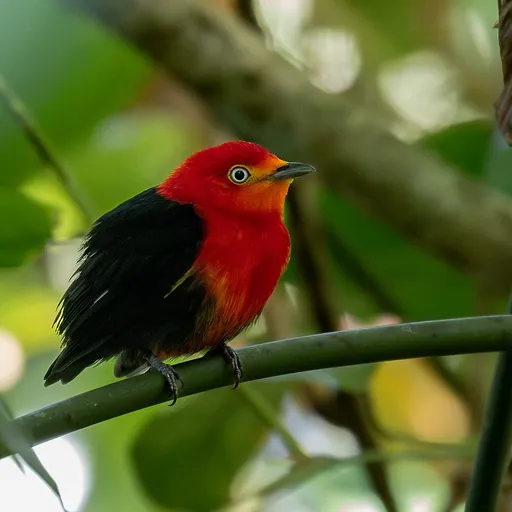
Crimson-hooded Manakin
Pipra aureola
Least Concern
Overview
The crimson-hooded manakin, also known as the orange-headed manakin, is a small passerine bird in the family Pipridae. It is a year-round resident of South America and is currently assessed as being of Least Concern by the IUCN.
Identification
- Males feature a distinctive crimson head, nape, and upper mantle with an orange-yellow face and throat, while the remainder of the plumage is mostly black with creamy thighs and a reddish vent.
- Females are olive-green on the head, upperparts, and wings, with a yellowish tinge to the lores and throat and diffuse yellowish streaks on the breast.
- Both sexes possess a blackish bill with pale grey markings and pink or purplish pink legs.
- Males emit a plaintive, drawn-out 'eeeeew' when perched and a sharper 'chee-weep', accompanied by a 'soft poop' sound from wing movement during display flights.
Habitat
Found in eastern Venezuela, French Guiana, Guyana, Suriname, and Brazil, this species inhabits a variety of landscapes, most of which are wet, including várzea forest, woodlands along watercourses, and secondary forest undergrowth. It is also present in coastal mangroves and, in some regions, in drier hilly areas near swamps. The bird typically occurs at elevations from sea level to 300 m, though it reaches 1,200 m near Cerro Roraima in Venezuela.
Diet
The crimson-hooded manakin feeds primarily on fruits, with a preference for those of the Araceae family, as well as insects and spiders. It plucks food items while perched and also takes them with short sallies from the perch.
Did you know?
Males perform a complex courtship display that involves sliding side-to-side and back-and-forth on a perch, facing away from rivals, and executing slow and fast swooping flights between perches. The wings produce a distinct 'soft poop' sound at the lowest point of the swoop and a 'click' when landing.
Sources
- Wikipedia · CC BY-SA 4.0
- Wikidata · CC0 1.0