
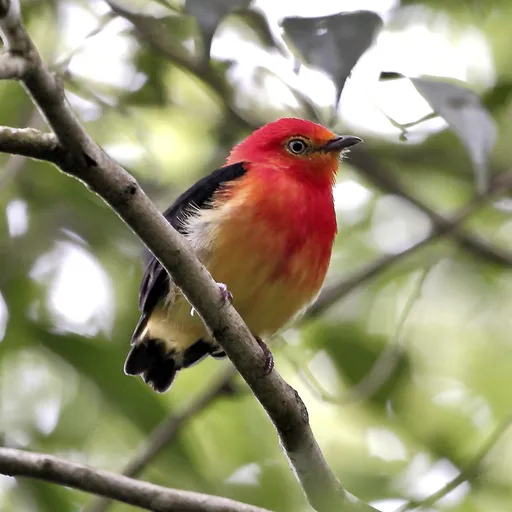
Band-tailed Manakin
Pipra fasciicauda
Least Concern
Overview
The band-tailed manakin (Pipra fasciicauda) is a small, frugivorous passerine bird in the family Pipridae. It inhabits humid montane and lowland tropical forests throughout Argentina, Bolivia, Brazil, Paraguay, and Peru. The species is classified as Least Concern on the IUCN Red List, although its population is believed to be decreasing.
Identification
- Males are sexually dimorphic with a yellow face and throat, red head and nape, black upperparts, and creamy yellow underparts; females are mostly dull olive-green with a yellow tinge on the face and breast.
- Small in size, measuring 10 to 11 cm in length and weighing 11.5 to 19 g, with a blackish bill featuring pale gray on the mandible and dull reddish legs.
- Males produce a "downward-inflected eeew" and a "harsh wee-ee-eeh" call at leks, while during flight displays they emit a "prolonged eeeooo" accompanied by low-pitched wingbeats described as "kloop".
- The nominate subspecies features a white tail base and a white patch on the inner webs of flight feathers that appears as a stripe in flight.
Habitat
Found in the southern Amazon Basin and the Pantanal region, the band-tailed manakin inhabits lowland várzea and gallery forests. Its elevational range extends up to 600 m in Brazil and 1,000 m in Peru. The species is a year-round resident with no documented movements.
Diet
Primarily frugivorous, the band-tailed manakin consumes fruits and seeds, which comprised 93% of fecal samples in a study in South Brazil, with the remaining 7% consisting of insect remains. They have also been recorded briefly following swarms of Eciton burchelli army ants.
Did you know?
The species constructs its tiny open cup nest entirely from fungal rhizomorphs, typically placing it in a branch fork 2 to 3 m up in a small tree. Hybridization between the band-tailed manakin and its sister species may occur due to slow evolution of reproductive isolation, allowing even taxa that diverged millions of years ago to interbreed upon contact.
Sources
- Wikipedia · CC BY-SA 4.0
- Wikidata · CC0 1.0