
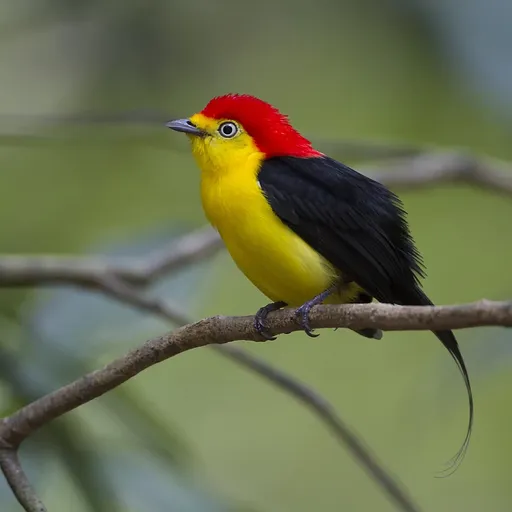
Wire-tailed Manakin
Pipra filicauda
Least Concern
Listen
XC248701 · Niels Krabbe · Sucumbíos: 'Sacha Lodge', n bank Río Napo, Ecuador · CC BY-SA 4.0
Overview
The wire-tailed manakin (Pipra filicauda) is a small species of bird in the family Pipridae, characterised by distinct tail filaments. It is found in the Neotropical regions of South and Central America, including Brazil, Colombia, Ecuador, Peru, and Venezuela.
Identification
- Body length is 11 to 12 cm, excluding the eponymous tail filaments, which add approximately 4 cm in males and 2.5 cm in females.
- Males of the nominate subspecies exhibit a bright red crown, nape, and neck sides with a yellow forecrown, face, throat, and underparts, contrasting with black upperparts and wings.
- Females are duller, featuring olive-green upperparts, a yellow-tinged face and breast, and a greyish lower belly.
- Males produce a downward-inflected 'eeew' call at leks, accompanied by a 'very low-pitched kloop' from their wings during display flight and a 'sharp klok' upon landing.
Habitat
This species inhabits a variety of somewhat open landscapes, including gallery forests, secondary forests, open woodlands, and in Venezuela, coffee and cacao plantations. It favours areas along watercourses across its range, occurring in elevations up to 1,000 m in Venezuela, 600 m in Brazil, and 500 m in Colombia and Ecuador.
Diet
The wire-tailed manakin feeds primarily on small fruits and insects. It forages by plucking food items while perched or during short flights from a perch.
Did you know?
During courtship, males perform a complex display flight where their tail filaments play an important role, yet only the dominant male at the lek is permitted to mate.
Sources
- Wikipedia · CC BY-SA 4.0
- Wikidata · CC0 1.0