
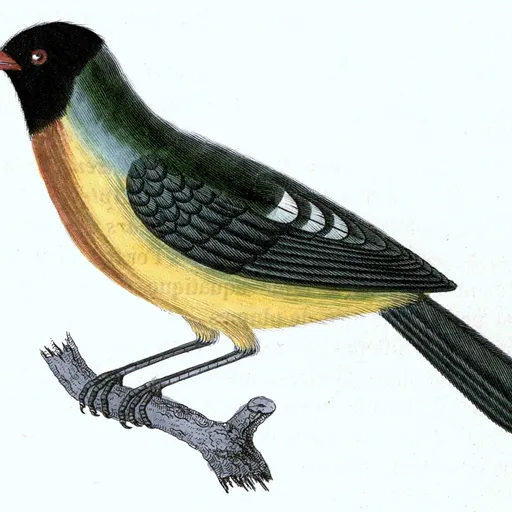
Handsome Fruiteater
Pipreola formosa
Least Concern
Overview
The Pipreola formosa is a species of bird in the family Cotingidae, commonly known as the cotingas. Endemic to Venezuela, it is currently assessed as Least Concern by the IUCN, although its population is believed to be decreasing.
Identification
- Measures 16 to 18 cm in length with a weight range of 32.5 to 49 g.
- Males possess glossy bluish black heads, bright grass green upperparts, and a deep orange triangular breast patch on otherwise yellow underparts; females are predominantly green with an orange-yellow breast crescent.
- Features a stout, curved bill that is bright orange in males and brownish yellow in females.
- Males typically have brownish legs with a yellow or olive tinge, whereas females have dark slaty gray legs.
- Sings in the morning from a mid-level perch, producing a high "peeEEEeeeeeee" call that is slower at the end, along with thin "pik" and "ti'ti" sounds.
Habitat
Found in somewhat humid to wet premontane forest and cloudforest at elevations between 800 and 2,200 m. The species has a disjunct distribution across the Venezuelan Coastal Range, with three subspecies located in the west, northeast, and on the Paria Peninsula.
Diet
Primarily feeds on fruit, including Gonzalagunia dicocca, Anthurium cartilagineum, and Melastomataceae fruits, supplemented by small insects. It typically forages singly, in pairs, or in small family groups, occasionally joining mixed-species feeding flocks. It perches quietly between 2 and 10 m above the ground, picking fruit while perched or briefly hovering after a short upward sally.
Did you know?
The species was first described in 1848 by Gustav Hartlaub under the name Ampelis formosa, and it was not until later that it was reclassified into the genus Pipreola.
Sources
- Wikipedia · CC BY-SA 4.0
- Wikidata · CC0 1.0