
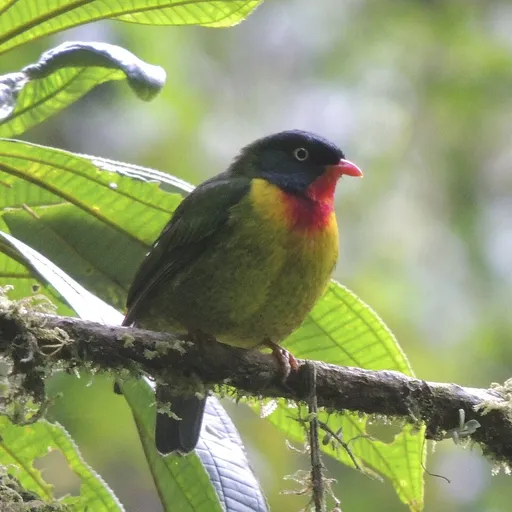
Scarlet-breasted Fruiteater
Pipreola frontalis
Least Concern
Listen
XC249824 · Niels Krabbe · Morona-Santiago: w-slope Cord. de Cutucú, Ecuador · CC BY-SA 4.0
Overview
The scarlet-breasted fruiteater (Pipreola frontalis) is a species of bird in the family Cotingidae. It is a plump, short-tailed cotinga restricted to the eastern slope of the Andes in South America.
Identification
- Plump, short-tailed bird measuring 15.5–16.5 cm in length, with bright green upperparts and narrow yellow tips on the tertials.
- Sexually dimorphic: males feature a bright red throat and upper breast, whereas females have yellow underparts marked with green scaling or spots.
- Legs and feet are pink or orange.
- The male's song varies by subspecies, ranging from a sharp, ascending "psii" to a longer, complex rising trill that ends in a descending whistle.
Habitat
Found in subtropical and tropical moist montane forests on the eastern slope of the Andes, spanning from northeastern Ecuador through eastern Peru to central Bolivia. It occupies elevations ranging from 900 to 2,000 metres above sea level.
Diet
Primarily frugivorous, this species eats fruit by pick-feeding while hover-gleaning or, less frequently, while perched. It tends to be rather lethargic and is often found higher in the tree canopy, from mid-levels to the sub-canopy, than other members of its genus.
Did you know?
The specific name frontalis is a Modern Latin word meaning "fronted" or "browed", despite the bird's most striking feature being its scarlet breast.
Sources
- Wikipedia · CC BY-SA 4.0
- Wikidata · CC0 1.0