
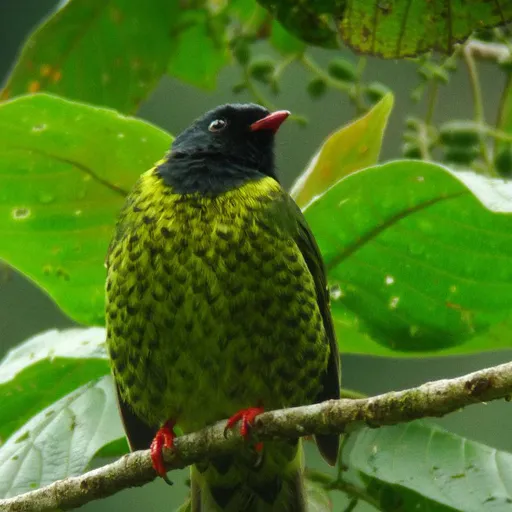
Band-tailed Fruiteater
Pipreola intermedia
Least Concern
Overview
The band-tailed fruiteater (Pipreola intermedia) is a species of cotinga found in the Andes of Peru and Bolivia. It was originally described as a subspecies of the green-and-black fruiteater but has been recognised as a full species since the early twentieth century.
Identification
- Males feature an entirely black head and upper breast with a thin yellow collar, while females have a green head and less black scalloping on the underparts.
- The tail displays a distinctive black bar near the end with white tips, a feature that distinguishes it from the similar green-and-black fruiteater.
- Both sexes possess a crimson bill with a sometimes black culmen, red or orange-red legs, and a yellow eye-ring.
- The song consists of very high notes followed by a thin, descending whistle, described as 'ti-ti-ti teeeeeeew'.
Habitat
Found along the eastern slopes of the Andes in Peru and Bolivia, the species inhabits the interior and edges of temperate montane forest. Elevations vary by subspecies, ranging from 2,100 to 3,000 m in Peru and down to 1,100 m in the south.
Diet
The band-tailed fruiteater is believed to feed exclusively on fruit, although specific details regarding its foraging behaviour are lacking.
Did you know?
Despite having a large range and being considered fairly common in Peru, the population size of the band-tailed fruiteater is unknown and is believed to be decreasing.
Sources
- Wikipedia · CC BY-SA 4.0
- Wikidata · CC0 1.0