
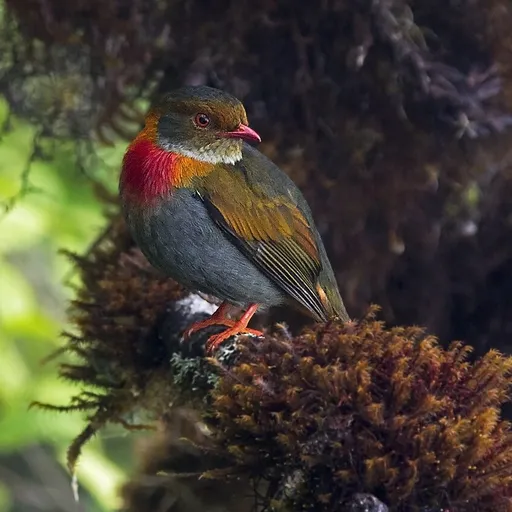
Red-banded Fruiteater
Pipreola whitelyi
Least Concern
Overview
The red-banded fruiteater (Pipreola whitelyi) is a species of bird in the family Cotingidae, often described as the most distinctive species within its genus. It is currently assessed as Least Concern by the IUCN, despite having a restricted range and a population believed to be decreasing.
Identification
- Adult males of the nominate subspecies feature a tawny-buff to rufous forehead, supercilium, and cheeks against a dark grayish green head, with rufous-brown wings and tail.
- Males display a red crescent on the upper breast that transitions to tawny on the sides of the neck, while underparts are mostly gray with ochre undertail coverts.
- Females possess a duller grayish green head and upperparts, yellowish white underparts with blackish streaks, and a duller red bill and legs compared to males.
- The bird is approximately 16.5 to 17.5 cm in length and produces a high, thin trill that drops initially before ascending smoothly, lasting 2–3 seconds.
Habitat
This species inhabits humid and wet montane forests, particularly dense secondary forest rich in moss and Melastomataceae understory. It ranges in elevation from 1,300 to 2,250 m and is found in the tepui region where eastern Venezuela, western Guyana, and extreme northern Brazil meet.
Diet
The red-banded fruiteater is believed to feed exclusively on fruit, though specific dietary details are lacking. It typically forages singly or in pairs within the lower to mid-levels of the forest, occasionally joining mixed-species feeding flocks.
Did you know?
The bird is considered difficult to locate and occurs at low density, often found in areas that are difficult of access. It rarely vocalises, seldom producing sound beyond its specific calls when excited.
Sources
- Wikipedia · CC BY-SA 4.0
- Wikidata · CC0 1.0