
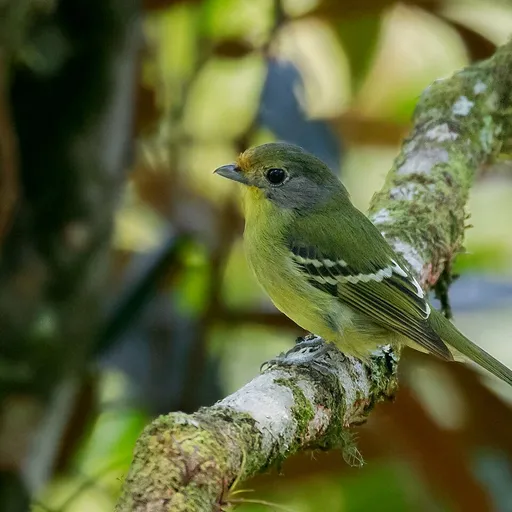
Wing-barred Piprites
Piprites chloris
Least Concern
Listen
XC251394 · Niels Krabbe · Napo: Napo Galeras, Ecuador · CC BY-SA 4.0
Overview
The wing-barred piprites (Piprites chloris) is a species of tyrant flycatcher found across mainland South America, with the exception of Chile and Uruguay. It is classified as Least Concern on the IUCN Red List and is generally considered uncommon to fairly common, though often localised, across its extensive range.
Identification
- A small bird measuring 12.5 to 14 cm in length and weighing 15 to 21 g, with identical plumage in both sexes.
- Characterised by golden lores and forehead, an olive-green crown, and bright yellow underparts with an olive cast on the breast.
- Olive-green upperparts and wings featuring distinct creamy to white bars on the closed wing coverts and paler green edges on the flight and tail feathers.
- Possesses a greyish bill, a dark iris, and light pinkish grey legs, accompanied by a rhythmic, far-carrying song often described as 'whip, pip-pip, pidipip, whip'.
Habitat
This species inhabits humid primary forest and mature secondary woodland, favouring dense understory and vine tangles within the canopy. Its distribution spans every mainland South American country except Chile and Uruguay, with elevation ranges varying from sea level to 2,000 m depending on the region.
Diet
The diet appears to consist mostly of insects and some small fruits, gleaned from foliage while perched or after briefly hovering following a sally. It typically forages alone but regularly joins mixed-species feeding flocks, operating from the mid-level to the canopy of the forest.
Did you know?
The only known nest structure for this species is a cup of moss constructed on the floor of a tree cavity. Breeding evidence is sparse, with only hints that the season in the northern part of the range includes May and June.
Sources
- Wikipedia · CC BY-SA 4.0
- Wikidata · CC0 1.0