
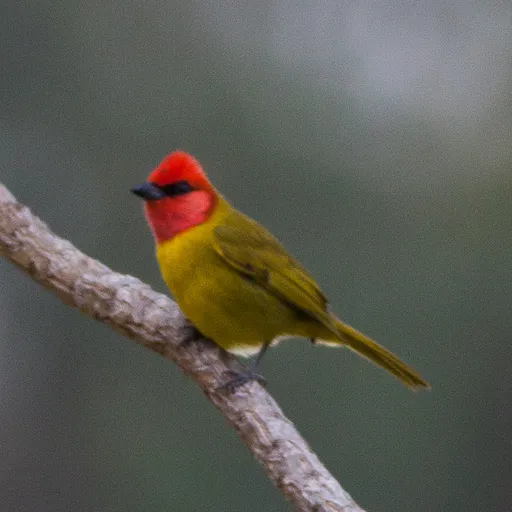
Red-headed Tanager
Piranga erythrocephala
Least Concern
Overview
The red-headed tanager, Piranga erythrocephala, is a medium-sized songbird endemic to Mexico and a member of the cardinal family. It is currently classified as a species of Least Concern by the IUCN, with a low near-term risk of decline.
Identification
- Approximately 15 cm (5.9 in) in length with a weight between 19.9 and 24.5 g.
- Males feature a red forecrown, face, throat, and upper chest, contrasting with bright yellow-olive upperparts and a narrow black mask.
- Females possess a yellow forecrown with yellow-olive upperparts and underparts that fade from yellow to buffy white.
- Song consists of long, slow phrases such as "chur chew che-wier chéé-chur" or "tsi-tsi tsee-tsee".
Habitat
Endemic to Mexico, the species inhabits a variety of wooded environments including semi-humid and moist montane forest, pine-oak forest, evergreen forest, and open woodland with scrub. It occupies elevations ranging from 900 to 2,600 m (3,000 to 8,500 ft) and may also be found along forest edges and in plantations.
Diet
This species forages in pairs or small groups, favouring the mid-level of trees or higher up in the foliage, though it occasionally forages at branch ends. Its diet consists of insects and small fruits such as berries.
Did you know?
The English naturalist William Swainson originally described the bird in 1827 using the name Spermagra erythrocephala based on material collected from Temascaltepec in Mexico.
Sources
- Wikipedia · CC BY-SA 4.0
- Wikidata · CC0 1.0