
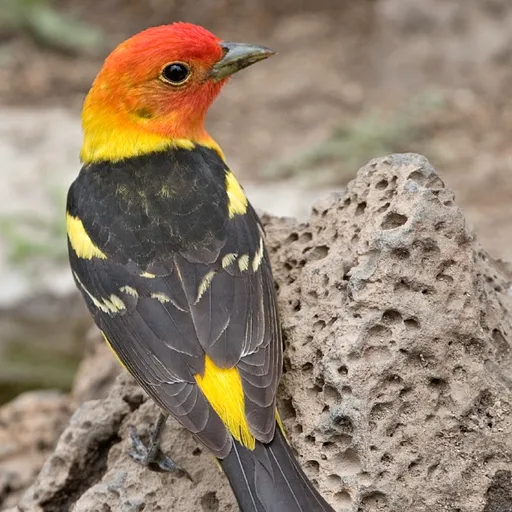
Western Tanager
Piranga ludoviciana
Least Concern
Listen
XC254618 · Jonathon Jongsma · Four Mile Draw Rd, Custer State Park, South Dakota, United States · CC BY-SA 4.0
Overview
The western tanager, Piranga ludoviciana, is a medium-sized American songbird currently classified within the cardinal family, Cardinalidae. Formerly associated with the tanager family, its plumage and vocalisations resemble those of other cardinalid species. The species is considered of Least Concern on the IUCN Red List.
Identification
- Adults feature pale, stout, pointed bills with yellow underparts and light wing bars.
- Male breeding plumage displays a bright red face, yellow nape, shoulder, and rump, contrasting with a black upper back, wings, and tail.
- Females possess a yellow head, an olive back, and dark wings and tail.
- The song consists of disconnected short phrases that are hoarser and more monotonous than an American robin’s, accompanied by a call described as pit-er-ick.
Habitat
Breeding habitats consist primarily of coniferous or mixed woods across western North America, ranging from the Mexico-U.S. border to southern Alaska. During migration and wintering, the species occupies pine and pine-oak woodlands, low-canopied scrub forests, forest edges, and even coffee plantations. They breed at a wide range of elevations, from approximately 56 m in the north-west up to 3,050 m in the south.
Did you know?
The western tanager is the northernmost-breeding tanager, reaching as far north as southern Alaska during the breeding season. A wild individual aged 7 years and 11 months has been documented through banding data, indicating a lifespan of several years.
Sources
- Wikipedia · CC BY-SA 4.0
- Wikidata · CC0 1.0