
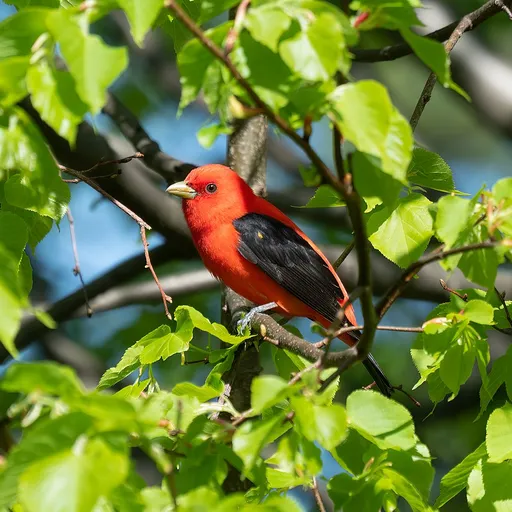
Scarlet Tanager
Piranga olivacea
Least Concern
Listen
XC795438 · steve · Hillsborough, Orange County, North Carolina, United States · CC BY-SA 4.0
Overview
The scarlet tanager (Piranga olivacea) is a medium-sized North American songbird in the cardinal family, Cardinalidae. It is a migratory species that breeds in eastern North America and winters in the Andean foothills of South America. Although populations are declining in some areas due to habitat fragmentation, the species is classified as Least Concern by the IUCN.
Identification
- Breeding males are crimson-red with black wings and tails, while females are yellowish on the underparts and olive on top.
- Males in winter and young birds resemble females but retain darker wings and tails.
- A mid-sized passerine ranging from 16 to 19 cm in length with a pale, horn-colored, fairly stout bill.
- The song is a hoarse version of the American robin's song, and the call is a distinctive chip-burr or chip-churr.
Habitat
The species breeds primarily in large stretches of deciduous forest, particularly those with oaks, across eastern North America. It can also inhabit young successional woodlands and suburban areas such as parks and cemeteries, provided the forest area is at least 10 to 12 hectares. During winter, they migrate to the montane forest of the Andean foothills in northwestern South America, passing through Central America.
Diet
Scarlet tanagers feed mainly on insects, including bees, wasps, beetles, and caterpillars, and they opportunistically consume fruit when insects are scarce. They forage high in trees, often using a method known as sallying to catch prey in flight, though they also capture food on the forest floor. When eating stinging insects like bees and wasps, they rake the prey against a branch to remove the stingers before consumption.
Did you know?
When capturing stinging insects such as bees, wasps, and hornets, scarlet tanagers perform a unique behaviour by raking the prey against a branch to remove their stingers before swallowing them.
Sources
- Wikipedia · CC BY-SA 4.0
- Wikidata · CC0 1.0