
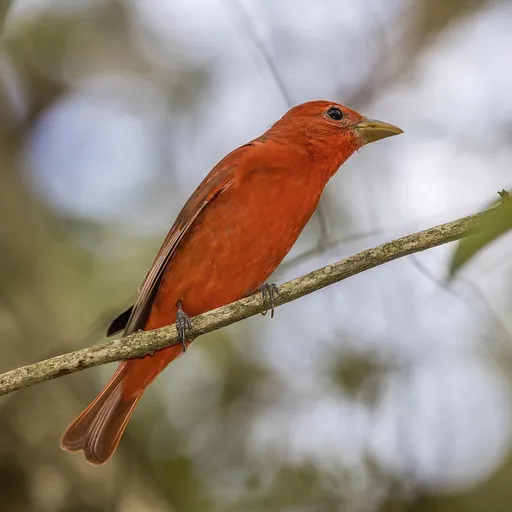
Summer Tanager
Piranga rubra
Least Concern
Listen
XC320483 · Jonathon Jongsma · Afton State Park, Washington County, Minnesota, United States · CC BY-SA 4.0
Overview
The summer tanager (Piranga rubra) is a medium-sized American songbird currently classified within the cardinal family. It is listed as Least Concern by the IUCN Red List and is known for its striking coloration, which is derived entirely from its diet.
Identification
- Adult males are rose red, while females feature orangish underparts with olive upperparts and olive-brown wings and tail.
- Adults possess stout, pointed bills and measure approximately 17 cm in length with a wingspan of 28 to 30 cm.
- The song is similar to that of the American robin but is more monotonous, consisting of a constant stream of few distinct melodic units.
- A sharp, agitated call often described as 'pi-tuk' or 'pik-i-tuk-i-tuk' accompanies the song.
Habitat
The species prefers pine-oak and mixed forests in the southeastern United States, while favouring riparian lowlands in the southwest. It breeds across the southern United States and Northern Mexico, reaching as far north as Iowa and New Jersey, and overwinters in Mexico, Central America, and northern South America. It is noted as an extremely rare vagrant to western Europe.
Diet
Primarily insectivorous, these birds forage high in trees and sometimes fly out to catch insects in flight. They regularly supplement their diet with fruit, particularly the fruit of Cymbopetalum mayanum in their winter quarters, and have occasionally been observed eating larger invertebrates like snails or even attempting to eat vertebrates. They will also forage in human-altered habitats and can be attracted to bird feeders.
Did you know?
All the red and orange coloration found in their plumage is acquired strictly through their diet. A rare report from a migratory stopover in Mississippi documented an individual attempting to eat a green anole, a vertebrate prey.
Sources
- Wikipedia · CC BY-SA 4.0
- Wikidata · CC0 1.0