
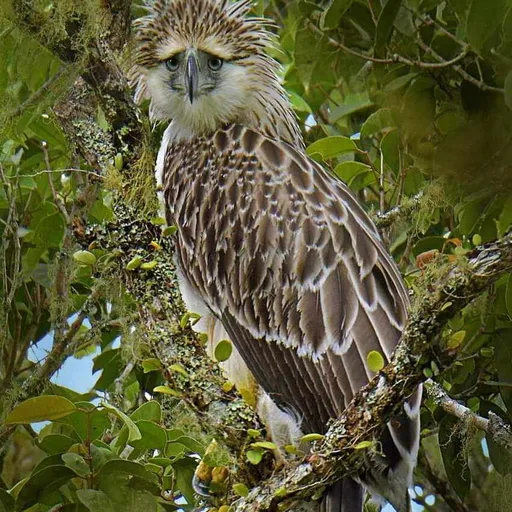
Philippine Eagle
Pithecophaga jefferyi
Critically Endangered
Overview
The Philippine eagle (Pithecophaga jefferyi), also known as the monkey-eating eagle, is a critically endangered species endemic to the forests of the Philippines. It is the largest extant eagle in terms of length and wing surface area and serves as the national bird of the Philippines.
Identification
- Features a shaggy, mane-like crest of long brown feathers on the nape, with a creamy-brown crown and dark face.
- Exhibits dark brown upperparts contrasting with white underparts and underwings.
- Possesses a bluish-gray, high-arched bill and heavy yellow legs with large, dark claws.
- Emits loud, high-pitched whistles ending with inflections in pitch, while juveniles beg for food with a series of high-pitched calls.
Habitat
This species inhabits dipterocarp and mid-montane forests, particularly in steep areas ranging from lowlands to elevations over 1,800 m. It is found on four major islands: eastern Luzon, Samar, Leyte, and Mindanao, where the largest population resides.
Diet
As an opportunistic apex predator, its diet primarily includes Philippine flying lemurs, which can constitute 90% of its intake in some locations, alongside macaques, reptiles, and various mammals. It employs still-hunting by sitting motionlessly on branches and perch-hunting by gliding through the canopy, sometimes using cooperative tactics to distract prey.
Did you know?
The eagle's flight is fast and agile, resembling smaller hawks rather than other large birds of prey. Killing a Philippine eagle is a criminal offence punishable by up to 12 years' imprisonment and heavy fines.
Sources
- Wikipedia · CC BY-SA 4.0
- Wikidata · CC0 1.0