
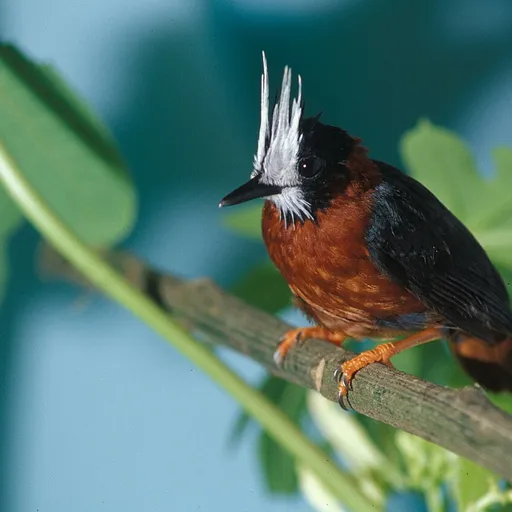
White-plumed Antbird
Pithys albifrons
Least Concern
Listen
XC248819 · Niels Krabbe · Orellana: Añangu, s-bank Río Napo, Ecuador · CC BY-SA 4.0
Overview
The white-plumed antbird (Pithys albifrons) is a small insectivorous bird belonging to the family Thamnophilidae, often referred to as the 'typical antbirds'. It is classified as Least Concern on the IUCN Red List due to its very large range and stable population across several South American countries.
Identification
- Adults feature distinctive white tufts on the forehead and chin, with a black crown and face.
- Upperparts and wings are grey, while the nape, tail, and underparts are rufous-chestnut with a grey tinge on the flanks.
- The bill is short, measuring approximately 1.16 cm in length, and the feet and tarsus are bright orange.
- Juveniles lack the white plumes and rufous-chestnut 'collar', appearing browner on the upperparts and greyer on the underparts.
Habitat
Found in Brazil, Colombia, Ecuador, French Guiana, Guyana, Peru, Suriname, and Venezuela, the species inhabits the understorey of terra firme evergreen forests in lowlands and foothills, as well as adjacent mature secondary forests. It thrives in areas with high canopies and vegetation complexity, occurring at elevations up to 2,250 m on Cerro Duida in Venezuela and 1,350 m in Brazil. The bird generally avoids open landscapes and does not cross rivers, though it may cross roads to move between forest patches.
Diet
An obligate antbird, it feeds almost entirely on insects, arthropods, and occasionally lizards disturbed by army ant swarms, with up to 20 individuals noted following a single swarm. Foraging typically occurs within 1 m of the ground, though it may feed up to 1 m above it, and it seldom joins mixed-species feeding flocks.
Did you know?
The species performs 'anting' by brushing small insects through its wing and tail feathers, a behaviour whose primary function remains unknown but may serve to ease irritation during molting, kill mites, or detoxify distasteful insects.
Sources
- Wikipedia · CC BY-SA 4.0
- Wikidata · CC0 1.0