
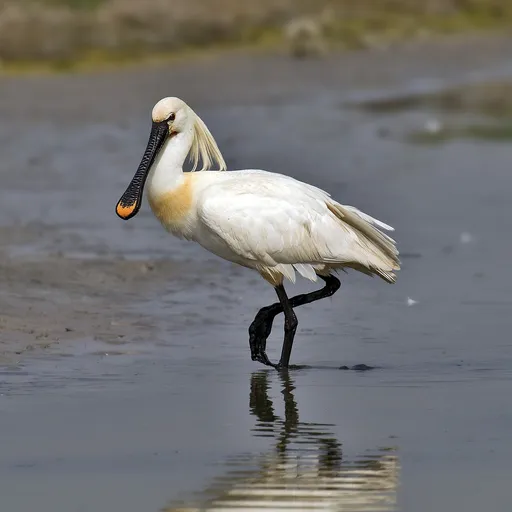
Eurasian Spoonbill
Platalea leucorodia
Least Concern
Listen
XC1042791 · Sonothèque ADVL · Saint-Jean-le-Thomas, Manche, Normandie, France · CC0 1.0
Overview
The Eurasian spoonbill, or common spoonbill, is a wading bird native to Europe, Africa and Asia. It is a partially migratory species, with more northerly breeding populations moving south for the winter, while southern populations remain resident.
Identification
- Breeding birds are almost entirely white, featuring a black bill with a yellow tip, dark legs, and a yellow breast patch, along with a head crest.
- Non-breeders lack the crest and breast patch, while immature birds have a pale bill and black tips on their primary flight feathers.
- Unlike herons, this species flies with its neck outstretched.
- Mostly silent, with occasional deep grunting, bill snapping, and trumpeting noises heard at breeding colonies.
Habitat
Eurasian spoonbills prefer extensive, shallow wetlands with muddy, clay or fine sandy beds, including marshes, rivers, lakes, floodplains and mangrove swamps in fresh, brackish or saline water. They favour locations with undisturbed nesting islands and dense riparian vegetation such as reedbeds and scattered willow, oak or poplar trees. In winter, they may also use sheltered marine habitats like deltas, estuaries and coastal lagoons.
Diet
Their diet consists of aquatic insects, mollusks, newts, crustaceans, worms, leeches, frogs, tadpoles and small fish up to 10–15 cm long. They forage by making sideways sweeps with their beaks to filter out tiny fish and shrimps, and may also ingest small fragments of aquatic plants.
Did you know?
In England, the Eurasian spoonbill was traditionally known as the "shovelard", a name that was later reassigned to the northern shoveler.
Sources
- Wikipedia · CC BY-SA 4.0
- Wikidata · CC0 1.0