
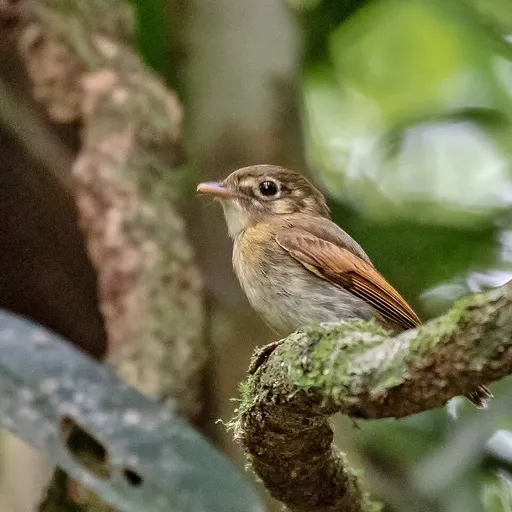
Russet-winged Spadebill
Platyrinchus leucoryphus
Vulnerable
Overview
The russet-winged spadebill (Platyrinchus leucoryphus) is a Vulnerable species of bird in the family Tyrannidae, the tyrant flycatchers. It is a year-round resident and the largest member of its genus.
Identification
- 12 to 12.5 cm long with a large head and a longer tail than other members of its genus.
- Olive-brown upperparts with wings that are brown with wide russet edges on the coverts and flight feathers.
- Wide flat bill featuring a yellow-edged black maxilla and a yellowish mandible, along with pale orange to dull pinkish legs and feet.
- Song is a weak, thin, buzzy trill described as 'bzee-eee-eép', accompanied by a loud 'ééo' call and a high, angry-sounding 'tjuw'.
Habitat
Found in southeastern Brazil, eastern Paraguay, and northeastern Argentina's Misiones Province. It inhabits the undergrowth of humid primary forest and mature secondary forest within the Atlantic Forest biome. Its range in elevation spans from sea level to at least 1,000 m.
Diet
Feeds on arthropods, typically foraging singly and occasionally joining mixed-species feeding flocks. It sits still in the crown of a small tree 3 to 8 m above the ground, capturing prey with short upward or outward sallies to grab them from the underside of leaves and twigs.
Did you know?
Its nest is a cup constructed from pieces of dead leaves and lichen fibers with small pieces of bark held on the outside by spider silk. Often, leaf and lichen pieces dangle from the bottom of the nest, which is typically placed in a branch fork 2.5 to 4.5 m above the ground.
Sources
- Wikipedia · CC BY-SA 4.0
- Wikidata · CC0 1.0