
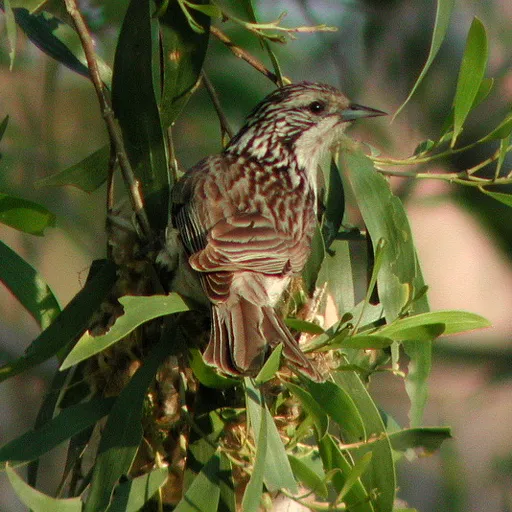
Striped Honeyeater
Plectorhyncha lanceolata
Least Concern
Overview
The striped honeyeater is a medium-sized passerine bird of the family Meliphagidae, native to eastern Australia. It is the sole member of the monotypic genus Plectorhyncha and is widely distributed across a variety of habitats, ranging from inland dry forests to coastal swamp forests. The species is currently listed as Least Concern on the IUCN Red List.
Identification
- Medium-sized honeyeater with a body length of 22–25 cm, featuring light greyish-brown upperparts with dark brown feather centres that create a striped appearance, particularly on the head and nape.
- Underparts are whitish with faint streaks on the belly, while the long, pointed feathers on the throat and upper breast give the head a spiky look.
- The bill is short, straight, and sharply pointed, appearing dark blue-grey grading to grey-black at the tip, with blue-grey legs and feet.
- Song consists of a sequence described as 'chirp, chirp, cherry, cherry', with a contact call of a sharp 'chewee' and a shrill, whistling alarm call.
Habitat
Primarily found in eastern Australia, the species inhabits dry open forests such as mallee, mulga, and heathland inland, and coastal swamp forests of paperbark and Casuarina. Its range extends from central and southeast Queensland inland to southeast South Australia, and along the coast to the Tuggerah Lakes in New South Wales. It also occurs in semi-arid scrubland and developed areas containing native and exotic trees.
Diet
Although it belongs to the honeyeater family, the striped honeyeater relies primarily on insects as its major food source, supplemented by seeds, fruits, and nectar from shallow flowers. It is an arboreal forager that gleans from leaves, probes under loose bark and in crevices, and occasionally hangs upside down to extract insects. It uses its specialized brush tongue to collect nectar and has a bill adapted for probing rather than long flower tubes.
Did you know?
The generic name Plectorhyncha derives from Ancient Greek meaning 'spear-point bill', reflecting its sharp beak, while the species name lanceolata refers to the lance-shaped feathers on the throat and breast. This bird will sometimes nest near a nesting butcherbird and has been known to incorporate human materials like tissue paper into its nest lining.
Sources
- Wikipedia · CC BY-SA 4.0
- Wikidata · CC0 1.0