
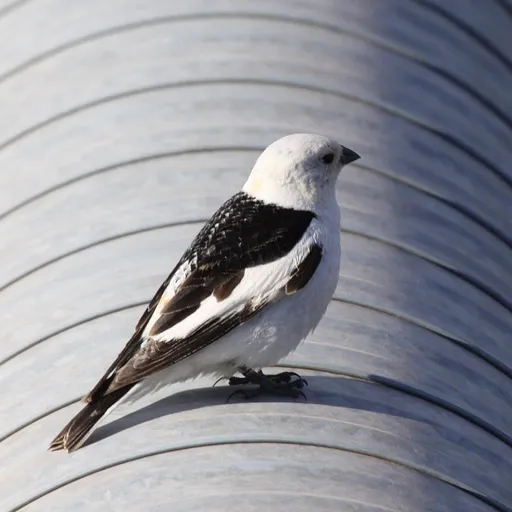
Snow Bunting
Plectrophenax nivalis
Least Concern
Listen
XC950366 · Sonothèque ADVL · Dragey-Ronthon, Manche, Normandie, France · CC0 1.0
Overview
The snow bunting (Plectrophenax nivalis) is a medium-sized passerine bird and an Arctic specialist with a circumpolar breeding range across the northern hemisphere. It is the most northerly recorded passerine in the world.
Identification
- Medium-sized passerine, approximately 15 cm long with a wingspan of 32–38 cm and a weight of 30–40 grams.
- Plumage is white underneath with black and white on the wings and back; breeding males have a white head, black back, and black wingtips, while females have back feathers fringed with brown.
- Bill is normally yellow with a black tip, except in summer males which have an all-black bill.
- Distinctive rippling whistle call described as 'per,r,r,rit' and a loud, brief warbling song.
- Possesses feathered tarsi, an adaptation to its harsh cold environment.
Habitat
Breeds in high Arctic tundra, rocky habitats, wet sedge meadows, and areas rich in dryas and lichens, with isolated populations on high mountain tops in places like the Cairngorms in Scotland and the Saint Elias Mountains in Alaska. In winter, it migrates to the circumglobal northern temperate zone, favouring open habitats such as farms, barren fields, and lakeshores.
Diet
During autumn to spring, it eats weeds such as knotweed, ragweed, and amaranth, along with grass seeds, foraging in the snow to collect seeds from lower stems. In summer, its diet includes seeds of crowberry, bilberry, and dock, as well as invertebrates like butterflies, flies, and spiders, which are the exclusive food for nestlings.
Did you know?
The snow bunting is the most northerly recorded passerine in the world, a distinction shared only with the common raven.
Sources
- Wikipedia · CC BY-SA 4.0
- Wikidata · CC0 1.0