
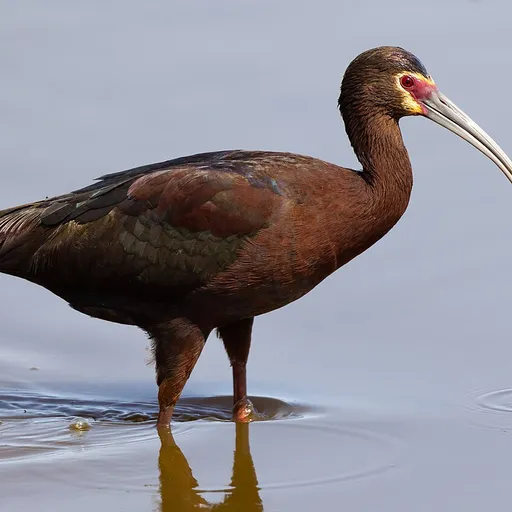
White-faced Ibis
Plegadis chihi
Least Concern
Overview
The white-faced ibis (Plegadis chihi) is a wading bird native to the Americas, classified as a species of Least Concern on the IUCN Red List. It belongs to the ibis family, Threskiornithidae, and is found across a broad range of habitats in North and South America.
Identification
- Non-breeding plumage is very similar to the glossy ibis but is slightly smaller and has a warmer colour.
- Breeding adults feature a pink, bare face bordered with white feathers, a grey bill, and redder legs.
- Adults possess red eyes year-round, distinguishing them from glossy ibises which have dark eyes.
- Measures 18.1–22.1 in (46–56 cm) in length with a wingspan of 35.4–36.6 in (90–93 cm).
Habitat
This species breeds colonially in marshes, typically nesting in bushes or low trees within dense vegetation such as bulrush, cattails, and shrubs. Its range extends from southwestern Canada and the western United States south through Mexico, as well as in southeastern Brazil, Bolivia, and Argentina. In North America, birds from northern breeding areas migrate south for winter, though some are increasingly sighted east of the Mississippi River in summer and autumn.
Diet
The white-faced ibis forages by using its bill to probe for prey, consuming a variety of invertebrates including insects, leeches, snails, crayfish, and earthworms. It also eats vertebrates such as fish, newts, and frogs.
Did you know?
Molecular phylogenetic studies suggest that the white-faced ibis may be paraphyletic, with US populations appearing more closely related to glossy ibises than to white-faced ibis populations in southern Brazil.
Sources
- Wikipedia · CC BY-SA 4.0
- Wikidata · CC0 1.0