
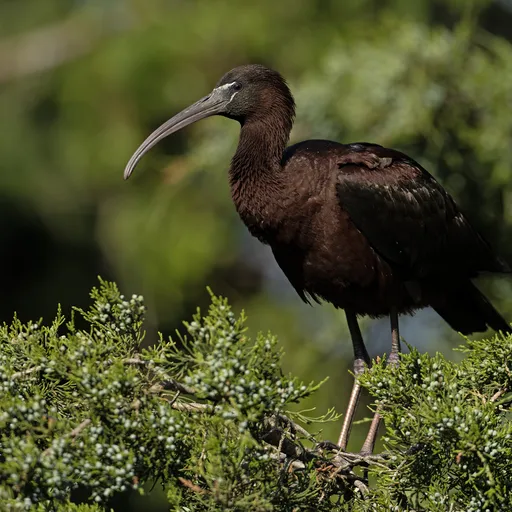
Glossy Ibis
Plegadis falcinellus
Least Concern
Listen
XC1047907 · Sonothèque ADVL · Genêts, Manche, Normandy, France · CC0 1.0
Overview
The glossy ibis (Plegadis falcinellus) is a mid-sized water bird and the most widespread ibis species, found across warm regions of the Old and New Worlds. It has expanded its range significantly in recent centuries, reaching parts of North America, Australia, and New Zealand.
Identification
- Length of 48–66 cm with an 80–105 cm wingspan, featuring a long, down-curved brownish bill.
- Breeding adults display reddish-brown bodies and strongly iridescent wing feathers that appear bottle-green to bronzed or purple depending on light angle.
- Non-breeding individuals and juveniles have duller bodies, with dark brown heads and necks finely streaked with white.
- Produces a variety of croaks and grunts, including a hoarse grrrr during breeding.
Habitat
This species inhabits freshwater or brackish wetlands with tall dense vegetation, preferring marshes at the margins of lakes and rivers. It can also utilise lagoons, floodplains, swamps, reservoirs, and agricultural wetlands such as paddies and irrigated farmland. While it typically roosts in large trees distant from feeding areas, it will use city trees and roadsides where human persecution is absent.
Diet
The diet is variable and season-dependent, consisting primarily of adult and larval insects, leeches, molluscs, and crustaceans. It occasionally feeds on fish, amphibians, lizards, small snakes, and nestling birds. Glossy ibises forage in very shallow water.
Did you know?
The species is known by the historical name 'black curlew', a term used in Norfolk until the early 19th century and found in Anglo-Saxon literature. A pair successfully bred in Cambridgeshire in 2022, marking the first confirmed breeding of glossy ibis in Britain.
Sources
- Wikipedia · CC BY-SA 4.0
- Wikidata · CC0 1.0