
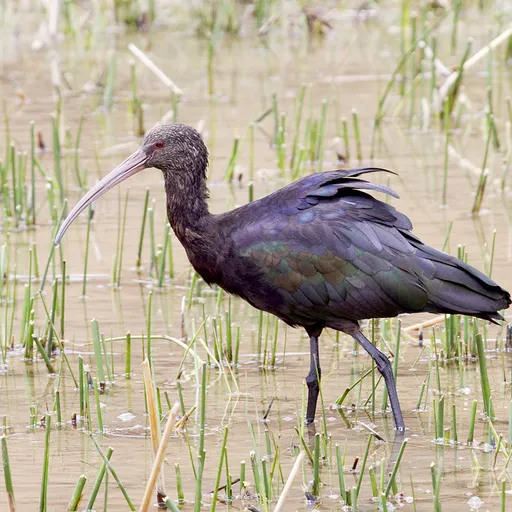
Puna Ibis
Plegadis ridgwayi
Least Concern
Overview
The puna ibis (Plegadis ridgwayi) is a medium-sized waterbird in the family Threskiornithidae, characteristic of the high Andean region. It is a social and migratory species that inhabits wetlands from high-altitude alpine zones down to coastal areas in South America.
Identification
- Medium-sized bird, 56–61 cm tall, with a long neck and dark purple-brown plumage that exhibits a purple or green iridescent sheen.
- Features a distinctive red, downward-curved bill.
- Breeding adults have a dark chestnut head and neck with a red face, while non-breeding and immature birds show white streaks on the head and neck and a duller face.
- Usually quiet, but when disturbed, emits a "wut" or "cwurk" call, with juveniles producing a whispering sound.
Habitat
The species occupies altitudinal and coastal wetlands, including swamps, marshes, lagoons, and flooded grasslands, primarily in Ecuador, Peru, Bolivia, northern Chile, and northeastern Argentina. It thrives in the altiplano and puna regions of the Andean highlands at elevations between 3,000 and 4,500 metres, though it also occurs from sea level to 5,000 metres and has been observed in artificial habitats like irrigation canals.
Diet
The puna ibis mainly feeds on invertebrates but may also consume amphibians and small fish when available. It forages by probing through water or mud with its long bill, often in small groups, and frequently adopts a curved back with raised feathers while feeding in shallow waters.
Did you know?
The species is known to participate in sunbathing, a comfort behaviour where the bird deliberately positions itself in the sun and adopts a unique posture, often preceded or followed by preening.
Sources
- Wikipedia · CC BY-SA 4.0
- Wikidata · CC0 1.0