
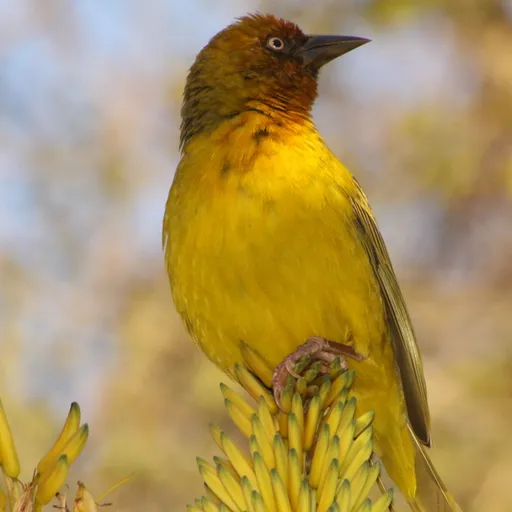
Cape Weaver
Ploceus capensis
Least Concern
Overview
The Cape weaver (Ploceus capensis) is a species of bird in the weaver family, Ploceidae, found in southern Africa. It is a stocky bird that forms large flocks and roosts, often shared with other bird species, and is classified as Least Concern on the IUCN Red List.
Identification
- A stocky bird approximately 17 cm long with streaked olive-brown upperparts and a long, pointed conical bill.
- Breeding males display a yellow head and underparts with an orange face and white iris, while adult females have an olive-yellow head and breast shading to pale yellow on the lower belly.
- The song is described as a harsh, rather hysterical sizzle, accompanied by a sharp double chip for alarm and a harsh "azwit" for contact.
Habitat
Endemic to South Africa, Lesotho, and Eswatini, the species occurs across much of the region excluding the Kalahari Desert, ranging from the Orange River in the Northern Cape south to the Cape of Good Hope and east to northern KwaZulu-Natal. It inhabits open grassland, lowland fynbos, coastal thicket, and farmland that provide permanent water and trees, avoiding forests and restricting to upland areas in hotter, arid regions.
Diet
The Cape weaver is omnivorous, with a diet evenly divided between animal and plant matter, particularly seeds, fruit, and nectar. It forages on the ground, in tree foliage, by gleaning from bark, and hawking insects in the air, acting as a major pollinator of aloes in South Africa.
Did you know?
Males are polygynous and may have up to seven females in a single breeding season, building multiple kidney-shaped, fully waterproof nests that they vigorously defend against other males.
Sources
- Wikipedia · CC BY-SA 4.0
- Wikidata · CC0 1.0